
Most nights I know my alarm first and work backwards from it. Some nights it goes the other way. It is already 11:40 p.m., I am only now brushing my teeth, and the question has flipped. I know when I am going to bed. What time should I wake up so tomorrow does not start in a fog? The answer is the same arithmetic run forward. Take the minute you expect to fall asleep, add whole sleep cycles, and set the alarm at the end of one.
That is the short version. The rest of this is how I do the sum, where the numbers come from, and how much weight they can carry.
Start from the time you will actually be asleep
For years I counted from the moment I got into bed. Getting into bed is not sleeping. There is the phone, the pillow flip, the one last thought about an email you forgot to send. Researchers call this sleep latency, which means how long it takes you to fall asleep once the light is off.
For most healthy adults it runs somewhere around 10 to 20 minutes. I use 15 minutes, and that is a rule of thumb, not a measured law. If you know you lie awake for half an hour most nights, use 30. The sum only works if the starting number is honest.
So the first step is small. Take the time the light goes off and add your usual time to drop off. That is your real start, and every cycle gets added to that minute, not to the minute your head touched the pillow.
The arithmetic, worked out for one night
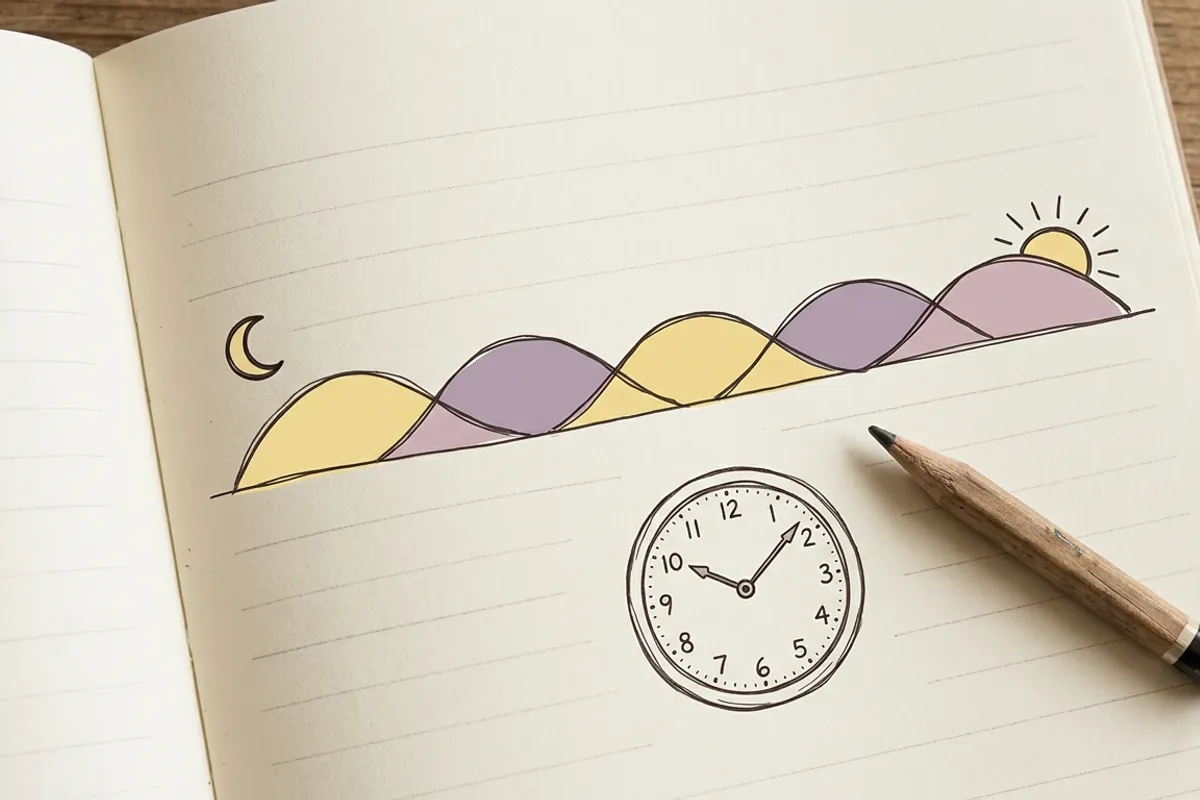
A sleep cycle is one full pass through the stages of sleep: light sleep, then deep sleep, then back up through dreaming sleep, the stage called REM. Carskadon and Dement, in Principles and Practice of Sleep Medicine, describe a cycle as roughly 90 minutes in adults. Yours may be 70 or 110, and it can drift from one cycle to the next within the same night.
Here is an ordinary night from my spreadsheet, rounded the way I round things when I am tired:
- Light off at 11:00 p.m.
- Asleep by about 11:15 p.m.
- Four cycles, six hours, ends around 5:15 a.m.
- Five cycles, seven and a half hours, ends around 6:45 a.m.
- Six cycles, nine hours, ends around 8:15 a.m.
Then I pick the one my day allows. On a work day that is usually 6:45 a.m. Five cycles puts me inside the 7 to 9 hours the National Sleep Foundation panel recommends for adults aged 18 to 64 (Hirshkowitz et al., Sleep Health, 2015). Four cycles does not. I only take the six hour option when the other choice is an alarm at 6:15 a.m. that goes off halfway through a cycle.
If you are 65 or older, the same panel puts the range at 7 to 8 hours. For teenagers aged 14 to 17 it is 8 to 10. Choose the number of cycles that lands you inside your range, then read the clock.
You can do this on paper. I did for a long time, and the carrying of hours past midnight is where I made most of my mistakes. The sleep calculator does the same sum, and it runs in both directions. Give it an alarm and it hands you bedtimes. Count from bedtime instead and you get wake times that land at the end of a cycle. The alarm-first direction has its own article: What time should I go to bed?
Why the end of a cycle matters more than the total
The feeling of being hit by a truck when the alarm goes off has a name. Sleep inertia is the slow, stupid stretch right after waking, when your reaction time and your judgment are worse than they will be an hour later. Tassi and Muzet reviewed the research on it in Sleep Medicine Reviews in 2000. One of the more consistent findings is that waking out of deep sleep makes that fog heavier than waking out of lighter sleep.
That is the whole reason to count in cycles. Near the end of a cycle you are closer to the surface. In the middle of an early cycle you are more likely to be deep down, and an alarm there drags you up through all of it at once.
One detail helps. Deep sleep is packed into the first half of the night, and the later cycles hold more REM and more light sleep. So by the fifth cycle, the difference between a well-timed alarm and a badly timed one is smaller than it would be at 3 a.m. The cycle count matters most when you are cutting a night short, which is exactly when people tend to skip the math.
I wrote more about the fog itself, and what does and does not clear it, in why you feel groggy after waking up.
How much the 90 minutes can be trusted
Here is the honest part. The 90 minute cycle is an average taken from sleep lab recordings. It is not a metronome inside your head. Cycles vary between people and within the same person on the same night. The first one is often shorter. A night that follows several short ones can pull in extra deep sleep early and push everything after it around.
That means the further you count, the more error piles up. After one cycle you might be ten minutes off. After five, you could be half an hour off in either direction, and the wake up time you planned so carefully lands mid-cycle anyway.
I saw this in my own columns. Some weeks 6:45 a.m. was easy. Other weeks the same alarm felt like being hauled out of a well, and my bedtime had not moved at all. What had moved was harder to see: late dinners, a stressful week, a run of short nights before it.
So I treat cycle math as a way to avoid the obvious mistake, like a seven hour alarm set without adding the time it takes to fall asleep. It is not a promise. If a wake time keeps feeling bad, I shift it 15 minutes earlier or later and keep it there for a week before I judge it. The spreadsheet has a column for exactly that, and that column has saved me more mornings than the averages have.
Is there a best time to wake up?
People ask this as if there were one number. There is not one I can give you honestly.
What the research does support is that your body has its own preferred timing, called a chronotype, which is roughly whether you lean early or late. Roenneberg and colleagues surveyed about 25,000 people and reported in Current Biology in 2004 that sleep timing gets later through the teenage years, peaks around age 20, and then drifts earlier for the rest of adult life. Two healthy adults can have preferred wake times hours apart, and neither one is doing it wrong.
The same research group described what they called social jetlag (Wittmann et al., Chronobiology International, 2006). It is the gap between when your body would sleep on a free day and when the alarm makes you get up on a work day. A big gap between weekdays and weekends behaves a bit like flying a few time zones east every Monday.
Regularity seems to matter as much as the exact hour. A small study of college students by Phillips and colleagues in Scientific Reports in 2017 found that the irregular sleepers had body clocks running later than the regular sleepers, even though their total sleep was about the same.
Waffles settled this question for me without asking my opinion. She is a tabby and she wants breakfast at 5:40 a.m. every single day, Sundays included, the Sunday after a wedding included. For a while I fought her with a later weekend alarm and a pillow over my head, and by Monday I felt like I had flown in from somewhere. When I gave in and moved my weekday wake time close to hers, Mondays stopped feeling like travel. I am not recommending a cat as a sleep plan. I am saying my weekend lie-ins were costing me more than they gave back.
So my working answer to the best time to wake up is this: the end of a cycle, at close to the same clock time every day, as near to your natural lean as your life allows.
When the numbers do not fit your morning
Sometimes the math says 6:45 a.m. and your bus says 6:20 a.m. Then you have two honest options. Go to bed earlier, so that five cycles end before 6:20 a.m., which means asleep by 10:50 p.m. and the light off around 10:35 p.m. Or accept four cycles for that night and know you are running a small deficit.
That deficit is the part people forget. One six hour night is survivable. Five in a row add up to several hours missing by Friday, and no clever wake time fixes that. If you keep landing on four cycles, the sleep debt calculator will show you the running total, and it is usually bigger than it feels. If every morning is a fight regardless of timing, can't wake up in the morning goes through what to check first.
A word on snooze, because it undoes all of this. Timing an alarm to the end of a cycle and then buying nine more minutes puts you back into light, broken sleep. The one lab study I know of, on habitual snoozers, found half an hour of it did no measurable harm, but those minutes are not real rest, and in my own mornings the second waking was always worse than the first. If your hand reaches the button before you are awake, how to stop snoozing is the piece I wish I had read years earlier.
If you sleep a full, regular 7 to 9 hours and still wake exhausted most days, talk to a doctor, because that is past what arithmetic can tell you. My about page says plainly what I am and am not.
Setting it up tonight
Decide when the light goes off, and be honest about how long you usually take to fall asleep. Add that to the clock. Count forward in 90 minute steps until you are inside your 7 to 9 hours, and set the alarm on the step your morning can live with.
Then keep that time tomorrow, and the day after, and write down how each morning felt. A week of notes will tell you more about your own cycles than any average in a textbook.
If you would rather not do sums in the dark, put tonight's bedtime into the sleep calculator and let it do the counting while you finish brushing your teeth.