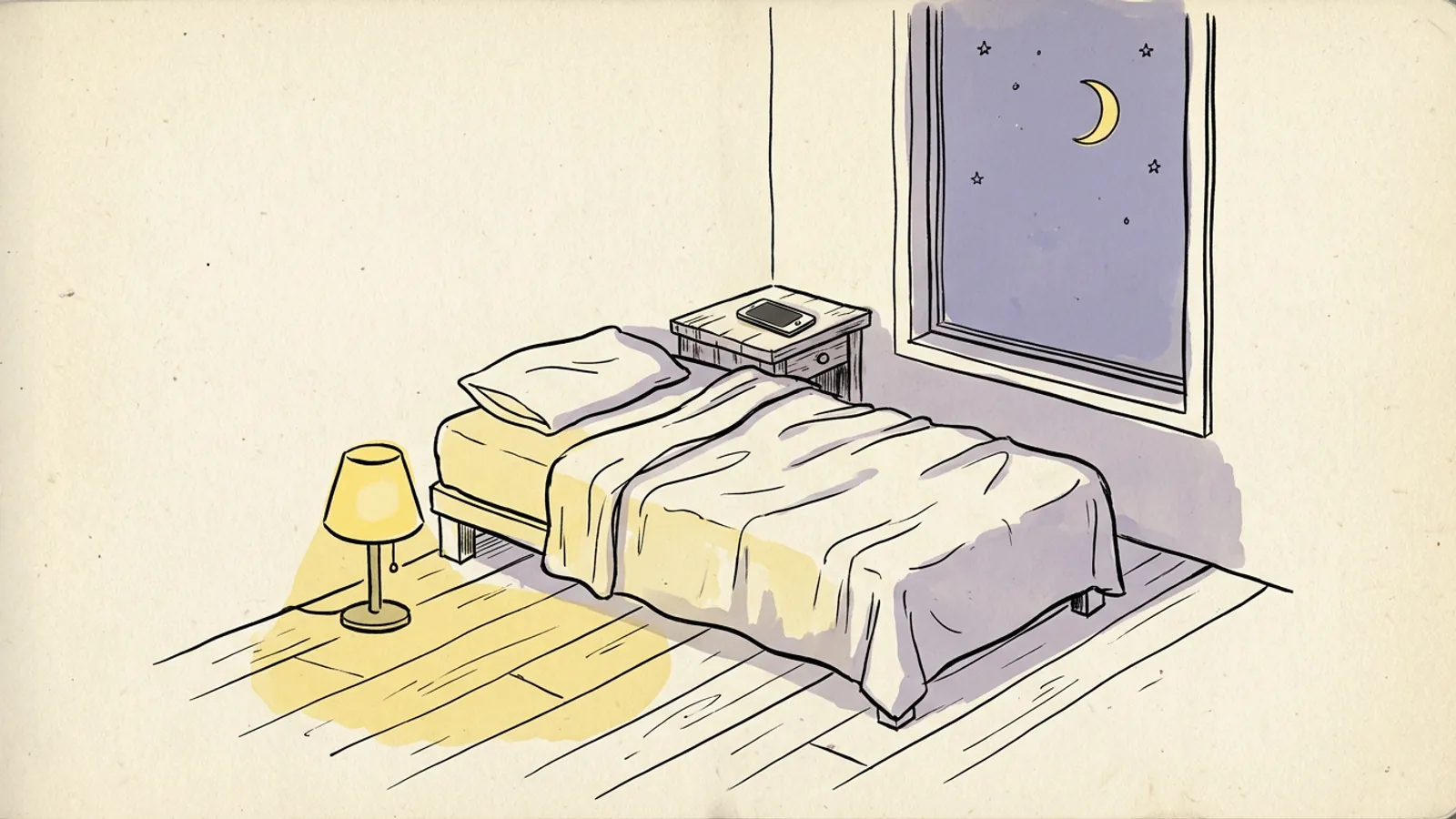
I spent years trying to improve sleep hygiene the way the posters say to, and most of what I changed made no difference I could measure. Two things did. One was the light I sat under after work, and the other was the time my alarm went off. The rest of the usual list turned out to be smaller than advertised, and for some of it I could not find any research at all. This is the version I kept, with the studies behind each piece and the places where the evidence is thin.
What sleep hygiene is, and how much the research backs it
Sleep hygiene is the name for the everyday habits around sleep. It covers when you go to bed, what you drink, how bright and warm the room is, and what you do in the hour before the light goes off. The list is old. Most reviews trace it to the psychologist Peter Hauri in the late 1970s, and it has been copied from pamphlet to pamphlet ever since.
The most honest summary of the evidence I have found is a review by Irish, Kline, Gunn, Buysse and Hall in Sleep Medicine Reviews, 2015. They went through the usual sleep hygiene techniques one at a time. A few had decent support: keeping caffeine and alcohol away from bedtime, and keeping a regular schedule. Others rested on a handful of small studies. Their conclusion was that the habits are reasonable, the evidence is uneven, and the list on its own has a weaker record than its popularity suggests.
That matched my spreadsheet. When I changed six things in one week, I could not tell which one mattered. When I changed one thing and waited two weeks, I could.
So I stopped treating it as a checklist. The useful work is finding the one or two habits that move your own numbers, and knowing which ones have a study behind them.
Light is the lever I ignored for years
The call center closed at 2 a.m. I would be home by 2:40, eat a bowl of cereal under the big overhead kitchen light, then watch something on my laptop in bed because I felt too wired to sleep. I blamed the job for feeling wired. Most nights I was still awake at 5, and I wrote "couldn't settle" in the notes column so often that I started abbreviating it.
I did not know then that the kitchen light was part of the problem. Your body starts releasing melatonin, the hormone that signals night has begun, as the light around you fades. Gooley and colleagues, in the Journal of Clinical Endocrinology and Metabolism in 2011, kept volunteers in ordinary room light before bed instead of dim light. The room light delayed their melatonin. It also cut the part of the night when melatonin was high by roughly 90 minutes. This was ordinary indoor lighting, the kind in every kitchen.
Screens add a little on top of that. Chang and colleagues, in PNAS in 2015, had people read either on a tablet with a lit screen or from a printed book before bed. After the tablet, people took around ten minutes longer to fall asleep and felt less alert the next morning. It was a small study of twelve people, so don't lean hard on the exact number. The direction is what counts.
The other half is daylight, and back then I would have laughed at it. Wright and colleagues, in Current Biology in 2013, sent people camping for a week with no electric light. Their body clocks moved about two hours earlier, and the gap between the night owls and the early risers mostly closed. You do not need a tent. You need bright light soon after you wake and dim light in the last hour before bed.
These are the changes I made and kept:
- After about 9 p.m. I used a low lamp instead of the ceiling light. On the late shifts, I switched as soon as I got home.
- The phone went to its dimmest setting, and I stopped using the laptop in bed.
- On day shifts I spent ten or fifteen minutes outside in the morning, even under clouds, which are still far brighter than an office.
If I could keep only one habit, it would be the morning light. And if you want the last hour laid out step by step, a 30 minute bedtime routine counts it back from the alarm.
Keep the wake time, and let bedtime follow it
Of everything on the list, a steady wake time did the most for me, and the research backs it better than most of the other habits.
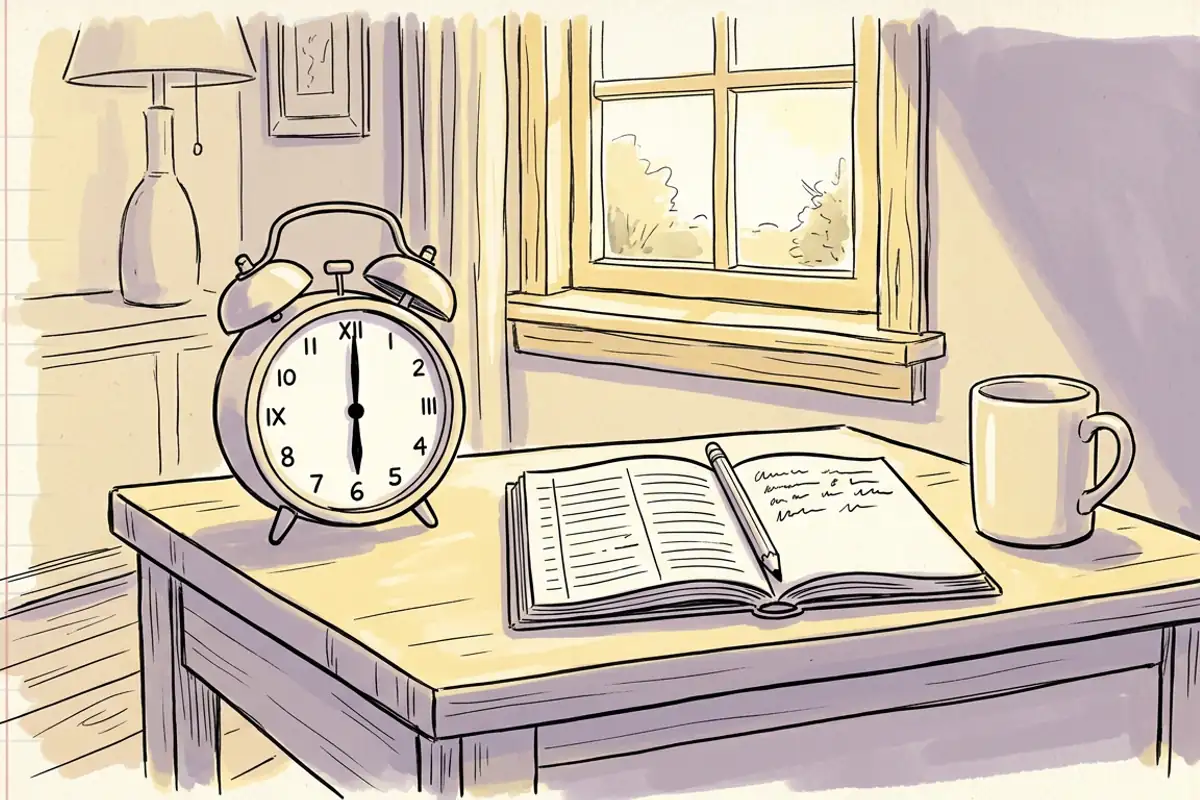
Phillips and colleagues, in Scientific Reports in 2017, tracked college students' sleep for a month. The students with the most irregular schedules had body clocks running roughly two and a half hours later than the regular sleepers, even though they slept about as many hours. An irregular week works on your clock like a short flight every weekend.
The trick is to fix the end of the night, not the start. You can decide when your alarm goes off, but you cannot decide the minute you fall asleep. So I pick the wake time first and count backwards from it, which is the whole idea behind the spreadsheet.
Here is how the counting works. A full sleep cycle, the loop from light sleep into deep sleep and back through dreaming, runs roughly 90 minutes, and yours may be 70 or 110. That figure comes from Carskadon and Dement in Principles and Practice of Sleep Medicine, and I wrote about why it varies in the 90 minute sleep cycle. Then add about 15 minutes for how long it takes you to fall asleep once the light is off. That 15 is a rule of thumb, not a measurement of you.
For a 6:30 a.m. alarm, five cycles back plus 15 minutes puts lights out at 10:45 p.m. Six cycles puts it at 9:15 p.m. The sleep calculator does this arithmetic for any wake time and gives you four bedtimes to choose from.
How many cycles you need is a separate question. The National Sleep Foundation panel (Hirshkowitz et al., Sleep Health, 2015) put most adults at 7 to 9 hours, which is five or six cycles for most people. Keep the same wake time on days off, or within an hour of it. I defended the weekend lie-in longer than any other habit, and it cost me the most on Monday.
If your schedule has already drifted, how to reset your sleep schedule walks through moving it back 15 minutes a night.
Caffeine and alcohol, counted on a clock
These two have better evidence than most of the list. Both act on a delay, which is why they are easy to miss.
Caffeine stays in your body for hours. Drake, Roehrs, Shambroom and Roth, in the Journal of Clinical Sleep Medicine in 2013, gave people a large dose of caffeine at bedtime, three hours before bed, or six hours before. Even the dose six hours out cut total sleep by more than an hour, and people often did not notice they had slept worse. The dose was about what you would get from four cups of brewed coffee, so a single mug does less. Still, six hours is the minimum, not a safe line. I went through the numbers in how long before bed to stop drinking coffee, and the caffeine cut-off calculator turns your bedtime into the time of your last coffee.
Alcohol is the one people defend. It does help you fall asleep faster. But a review by Ebrahim, Shapiro, Williams and Fenwick in Alcoholism: Clinical and Experimental Research in 2013 found it also breaks up the second half of the night, with more waking once the body has processed it. I used to count a beer after work as a sleep aid. My notes column disagreed. Those were the nights I woke at 6 a.m. and could not get back to sleep.
Now I have my last coffee before noon on a day shift, and I stop drinking alcohol about three hours before bed. The three hours is my own rule of thumb, not a number from a paper.
The room, and the tricks that did nothing for me
A cool, dark, quiet room helps, and the research supports that in general. A review by Okamoto-Mizuno and Mizuno in the Journal of Physiological Anthropology in 2012 found that heat and humidity cut into both deep sleep and dreaming sleep. The often quoted bedroom temperature of about 65 to 68 degrees Fahrenheit is a rule of thumb, and people differ. If you wake up hot, try a cooler room first.
Darkness mattered more than I expected when I slept during the day after a night shift. Blackout curtains were the one thing I bought in that whole period that earned its place. Earplugs helped with traffic noise, and a fan helped with both heat and noise.
These did nothing for me, or had little research behind them:
- A lavender pillow spray. I used it for a month and saw no change in the notes column. The studies on scent and sleep I could find were small and mixed.
- A strict rule that the bed was only for sleep. I kept it while still using my phone in the next room until midnight. The rule was fine. The light was the problem.
- A new pillow, bought to fix what turned out to be a schedule that moved three hours every weekend.
Poor sleep hygiene usually comes down to one or two big things, not twenty small ones. For me it was light and an irregular wake time. A new pillow did nothing while those two stayed the same.
When good sleep hygiene habits are not enough
Habits only go so far. If you are short on sleep across the whole week, a tidy bedroom will not pay that back in one night. The sleep debt calculator adds up what you missed, and what sleep debt is explains why one long Saturday does not cover it.
Shift work is its own problem, because the light and the clock work against each other. I wrote down what I learned in my night shift sleep schedule.
If you have kept the basics for a few weeks and still lie awake most nights, snore loudly, stop breathing in your sleep, or feel exhausted no matter how long you sleep, talk to a doctor, because insomnia, sleep apnea and other sleep disorders are medical questions, and I explain what I am and am not on my about page.
What to change tonight
Pick one habit, not the whole list. If I had to choose for you, it would be these two, in this order.
First, set a wake time you can keep seven days a week. Put it into the sleep calculator and choose the bedtime that gives you five or six cycles. Second, an hour before that bedtime, turn off the ceiling light and use a lamp.
Write down when you went to bed and how you felt at noon the next day. After two weeks you will have a small spreadsheet of your own, and it will show you which change is working.