
For about two years I treated the 90 minute sleep cycle as a fixed fact. I had read it somewhere, typed 90 into a cell in my spreadsheet, and planned every night around it. Then a second column started to disagree with the first. The first column said when I should wake up feeling fine. The second said how I actually felt, and on a lot of mornings the two did not match.
This was the call center years. We closed at 2 a.m., I was in bed by 3:15, and I did the pillow math the way I had learned it: 15 minutes to fall asleep, five cycles of 90 minutes, alarm at 11:00 a.m. I woke up feeling like wet cardboard most days that month. So I started moving the alarm ten minutes at a time and scoring each morning from 1 to 5. By the end of the next month the good scores clustered around 11:25. Spread over five cycles, that works out to about 95 minutes a cycle. Or it means I took longer to fall asleep than I thought. The spreadsheet could not tell those apart, and I still can't.
That is the whole article in small. Ninety is a real number and a useful one. It is also an average, and yours may be 70 or 110.
Where the 90 comes from
Sleep is not one flat state. Through the night you move from light sleep into deeper sleep, then into REM, the stage where most vivid dreaming happens, and then the loop starts over. One lap of that loop is a sleep cycle.
The loop was first spotted in the 1950s. Eugene Aserinsky and Nathaniel Kleitman reported rapid eye movements during sleep in Science in 1953. A few years later William Dement and Kleitman showed, in Electroencephalography and Clinical Neurophysiology in 1957, that those REM periods came back at fairly regular intervals across the night.
Decades of lab recordings since then have put the typical lap at around an hour and a half. Ninety is a tidy round figure, easy to multiply, and it ended up on sleep sites, pillow packaging and fitness apps. Somewhere in all that copying, the word "average" fell off.
How long is a sleep cycle, really
The reference I trust most here is Carskadon and Dement's chapter on normal sleep in Principles and Practice of Sleep Medicine. Their figures put the first cycle of the night at roughly 70 to 100 minutes. The second and later cycles run roughly 90 to 120 minutes.
So when someone asks how long is a sleep cycle, the honest answer has three parts. Roughly 90 minutes on average. Yours may be 70 or 110. And your own cycles are not all the same length, even within one night.
Those ranges come from lots of sleepers averaged together. What I wanted to know for my spreadsheet was narrower: does one person's sleep cycle length stay put from week to week? The research on that is thinner than I would like. Cycle length does wander within a person, but I have not found a number for how much that I would stake a bedtime on. So I treat my own 95 as a rough guess that happened to work, not a measurement.
Early cycles and late cycles are built differently
This is the part that made me stop worrying about the exact number.
The cycles of a night have different insides. Early on they are heavy with deep sleep, the slow, hard-to-wake stage. As the night goes on, deep sleep shrinks and REM stretches out. The first REM period can be only a few minutes long. The last ones, toward morning, can run half an hour or more. Carskadon and Dement describe this same shape: deep sleep bunched into the first third of the night, REM piling up in the last third.
Why that matters for your alarm: waking out of deep sleep is what gives you the worst of the fog. Researchers call it sleep inertia, the groggy, slow period after waking, and Tassi and Muzet's review in Sleep Medicine Reviews, 2000, found it is heavier when you are woken from deep sleep. I wrote more about the fog and how long it lasts in why you feel groggy after waking up.
Put those two facts together and something useful falls out. By 6:30 a.m., after a full night, there is not much deep sleep left to be dragged out of. Landing ten minutes off a cycle boundary in the morning usually costs less than landing ten minutes off in a short night or a nap, when deep sleep is still heavy. A rough cycle number is forgiving at exactly the time most people use it.
What the sleep calculator assumes
I would rather you know what is under the hood than trust a list of times.
The sleep calculator takes your wake time and counts backwards in cycles of 90 minutes. It adds about 15 minutes for sleep latency, which is how long it takes you to fall asleep once the light is off. Then it gives you four bedtimes, each a whole number of cycles before the alarm.
Why 90 and not something personal? Because it sits in the middle of the range, and the calculator knows nothing else about you. It has no idea whether your cycles run short or long, and neither do most of us without a lab.
Why 15 minutes? That one is a rule of thumb. Plenty of people drop off in 5 minutes when tired and take 30 on a night when their head is busy. If you know you usually lie there for half an hour, move the bedtime it gives you 15 minutes earlier yourself.
There is one more thing the calculator does not know, and it is often the bigger one. If you are short on sleep across the week, no clever alarm time will make 6:30 a.m. feel good. The sleep debt calculator adds that up, and can't wake up in the morning is where I explain why I check debt before I blame the cycle count.
How far a wrong cycle length moves your bedtime
Here is the arithmetic, because the size of the error surprised me when I first ran it.
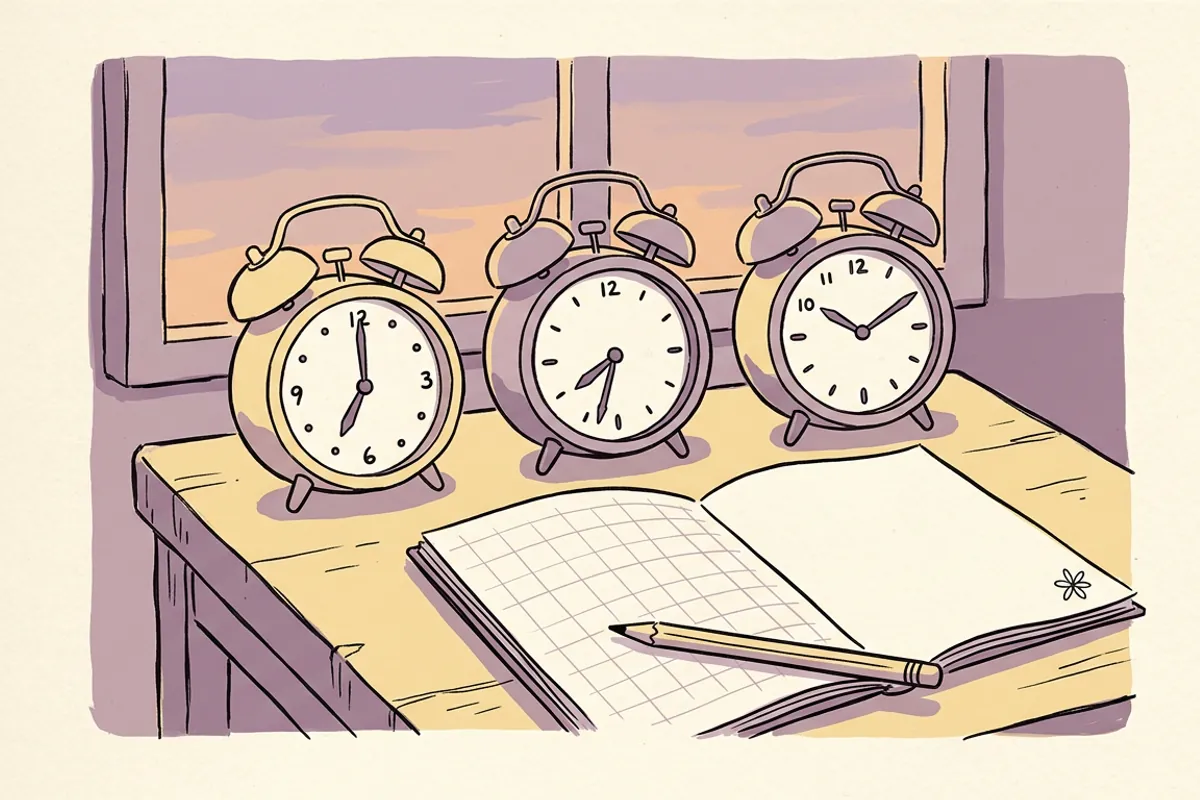
Say your alarm is at 6:30 a.m. and you want five cycles, with 15 minutes to fall asleep. Depending on your real cycle length, the right bedtime is:
- 80 minute cycles: 11:35 p.m.
- 90 minute cycles: 10:45 p.m.
- 100 minute cycles: 9:55 p.m.
That is a spread of 100 minutes between the short and long versions. The error grows with every cycle you count. If your cycles are 10 minutes longer than 90, you are 10 minutes off after one cycle and 50 minutes off after five.
Real nights are messier than that list. The first cycle tends to be shorter and the later ones longer, so the errors do not stack as neatly as the math suggests. But the direction holds: the more cycles you count, the more a wrong cycle length matters.
You might think the fix is to count fewer cycles so the error stays small. Please don't. Four cycles of 90 minutes is only six hours. The National Sleep Foundation panel (Hirshkowitz et al., Sleep Health, 2015) recommends 7 to 9 hours for adults. Five cycles is seven and a half hours and six is nine, which is why I aim for five or six and accept a bit of fuzz at the edges. A tidy count that leaves you short every night is a bad trade.
Finding your own number without a lab
You can't measure your cycles at home the way a sleep lab does. You can get a rough sense of where your good mornings land, which is what I did with the spreadsheet.
The version I would suggest:
- Keep your bedtime as steady as your life allows for two weeks.
- Set the alarm at the time the calculator gives you for three or four mornings.
- Within a minute of the alarm, before coffee, score how you feel from 1 to 5.
- Move the alarm ten minutes later for the next three or four mornings, and keep scoring.
- If you have room in your schedule, try ten minutes earlier too.
Then look at where the 4s and 5s gather. If they sit later than the calculator's time, your cycles may run long, or you may take longer to fall asleep than 15 minutes. Either way, the practical fix is the same: shift your bedtime by that amount.
Expect noise. A bad day, a late coffee or a warm room will wreck a score, and two weeks is a small sample. I ignored single mornings and only trusted a pattern that held for most of a week.
About trackers: watches and rings estimate your stages from movement and heart rate. They are reasonable at telling you roughly how long you slept. I don't trust their stage graphs to the minute, so I would not build a cycle length from one.
If you give it a full 7 to 9 hours and still wake exhausted most mornings, or someone tells you that you snore and stop breathing, talk to a doctor, because that is past what a spreadsheet can answer, and my about page says plainly what I am and am not.
What to try tonight
Put tomorrow's wake time into the sleep calculator and pick the bedtime for five or six cycles. Put a pen and a scrap of paper by the bed. When the alarm goes, write down a number from 1 to 5 before you do anything else.
That is day one of your own column. If you would rather start from the other end, from the minute you actually fall asleep, what time should I wake up counts forward instead of back. Ninety is the starting guess. A couple of weeks of scores will tell you whether yours is closer to 80 or 100.