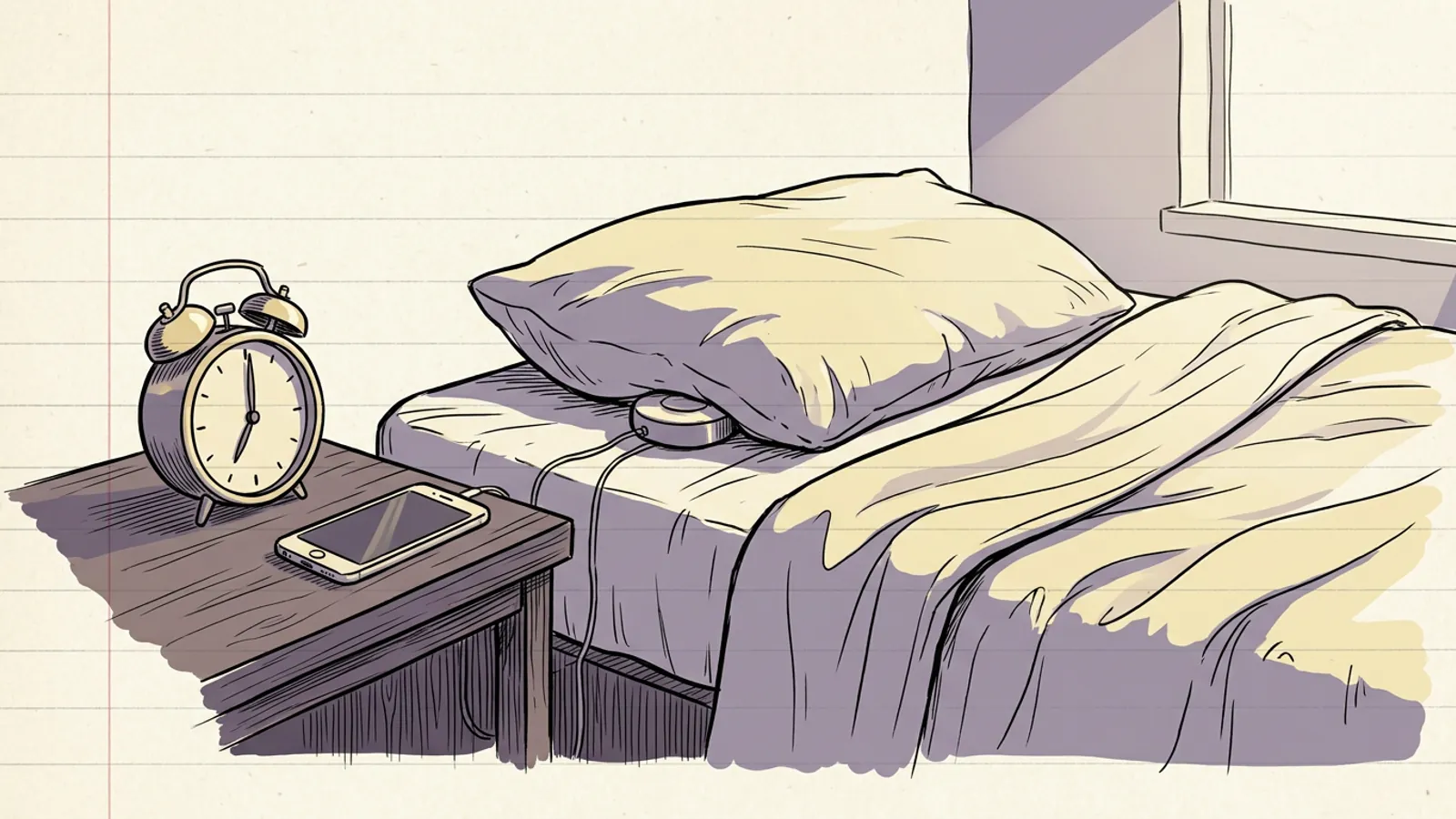
For years I was exactly the person an alarm clock for heavy sleepers is made for, and I slept through those too. My first week on warehouse nights I set three alarms for 2:30 p.m.: one on my phone, one on a wind-up clock by the bed, and the microwave timer in the kitchen. I woke at 4:10 p.m. in a dark apartment. The microwave had beeped its three beeps to nobody.
It took me a long time and a lot of ugly noises to work out what gets a heavy sleeper upright. Here is what held up, from the research on waking sleeping people and from the spreadsheet I still keep. I name the products I used, including the ones that stopped working.
The pitch matters more than the volume
Everyone tries louder first. I did. I bought a Sonic Bomb from Sonic Alert, a clock advertised at around 113 decibels. It worked for about a month, because it was new and horrible. Then my brain filed it under weather.
The best evidence on alarm sounds comes from an odd place: fire safety. Dorothy Bruck and her colleagues at Victoria University in Australia spent years testing which alarm sounds wake sleeping adults. They had a reason. The high beeping smoke alarm turned out to be poor at waking children, deep sleepers and people who had been drinking. Across several studies, including one in the Journal of Sleep Research in 2009, a low-pitched 520 Hz square wave woke people at lower volumes than the classic high beep of around 3000 Hz.
In plain words: a low, rough, buzzing tone gets through when a shrill one does not. Those studies were about fires, not Monday mornings, so treat the carry-over as a good guess and not a proof. It does match my own notes. The alarms that got me up were ugly low buzzers. The ones that failed were chirps and pleasant bells.
There is a wrinkle. A 2020 survey from RMIT University (McFarlane and colleagues, PLoS ONE) asked people about sleep inertia, which is the heavy, slow fog of the first minutes awake. People who woke to alarms with a tune reported less of that fog than people who woke to sounds with no tune to them. It was self-reported, so it is a hint and not a rule. My reading of the two together is that a harsh low sound is better at getting you awake, and something with a tune may be kinder once you are. You can use both: a melody first, then a buzzer five minutes later.
A few things that did not help me:
- Turning a phone to maximum volume. Phone speakers are small, and the loudest setting is mostly shrill treble.
- A new song every week. The novelty wore off faster than the week did.
- Waking to the radio. I learned to sleep through talk shows in about four days.
- A tone that ramps up slowly from silence. By the time it was loud, I had folded it into a dream.
Vibration gets through when sound does not
Sound has to get past the part of your brain that decides what is worth waking for, and that part learns. Vibration skips most of that. Bruck and Thomas (Ear and Hearing, 2009) tested alarms on adults who were hard of hearing. The low 520 Hz tone and bed or pillow shakers woke them far more reliably than flashing strobe lights did. Those were not typical sleepers, and I have never owned a strobe. But the part about touch matches what my spreadsheet says about me.
Your options, from cheapest up:
- A smartwatch or fitness band with a vibrating alarm. Apple Watch, Fitbit and many Garmin models do this. It buzzes against your wrist, which is hard to ignore, and it leaves the rest of the home quiet. The weak point is the battery. A watch that died at 3 a.m. wakes nobody, so charge it in the evening, not overnight.
- A bed shaker, a small puck that goes under the pillow or mattress and plugs into an alarm clock. The Sonic Bomb comes with one. That puck is what kept the clock useful for me, long after the noise alone had stopped doing anything.
- A standalone pillow vibration alarm, sold for people who are deaf or hard of hearing. Same idea, fewer buttons.
The combination I trust most is a shaker plus a low sound. On mornings after a short week, the sound alone failed. The shaker alone got me as far as a half-awake grope for the switch. Both together got me sitting up.
Missions that make you prove you are awake
Getting your eyes open is only part of it. The other part is not switching the alarm off in your sleep, which I did for years without remembering doing it.
This is what mission alarms are for. Alarmy is the best known. Before it stops ringing, you have to solve math problems, shake the phone a set number of times, scan a barcode, or photograph something you registered earlier, like your bathroom sink. The reasoning holds up. Sleep inertia slows your thinking, so a task that needs thinking drags you further awake than pressing a button does. The only study I know of is a small one that measured a morning exercise habit, not how awake people felt. It is a sensible idea with thin data behind it.
What I found:
- Math problems worked for about two weeks. Then I got fast at them half asleep. A harder setting bought me a few more weeks.
- The photo mission worked best, because the sink was in another room. Honestly, that was placement doing the work, which is the next section.
- Shaking the phone is easy to do lying down with your eyes shut. I would skip it.
If you want to see whether a math problem wakes you before you commit to an app, the online alarm clock on this site has an optional one to turn it off. It runs in a browser tab, so it suits a nap at a desk better than a full night. If Alarmy grates on you, I went through the other options in Alarmy alternatives, and the wider field in the alarm clock app roundup.
One warning. A mission that is too hard at 6 a.m. teaches you to uninstall the app at 11 p.m. Pick something you can finish in under a minute once you are up, and nothing you could do in your sleep. Finding that balance is the hardest problem for the alarm app I am building.
Where the alarm lives in the room
The oldest trick is still one of the best: put the alarm where you have to stand up to reach it. Standing, walking and switching on a light all push against the fog. And once you are up, getting back into bed becomes a decision and not a reflex.
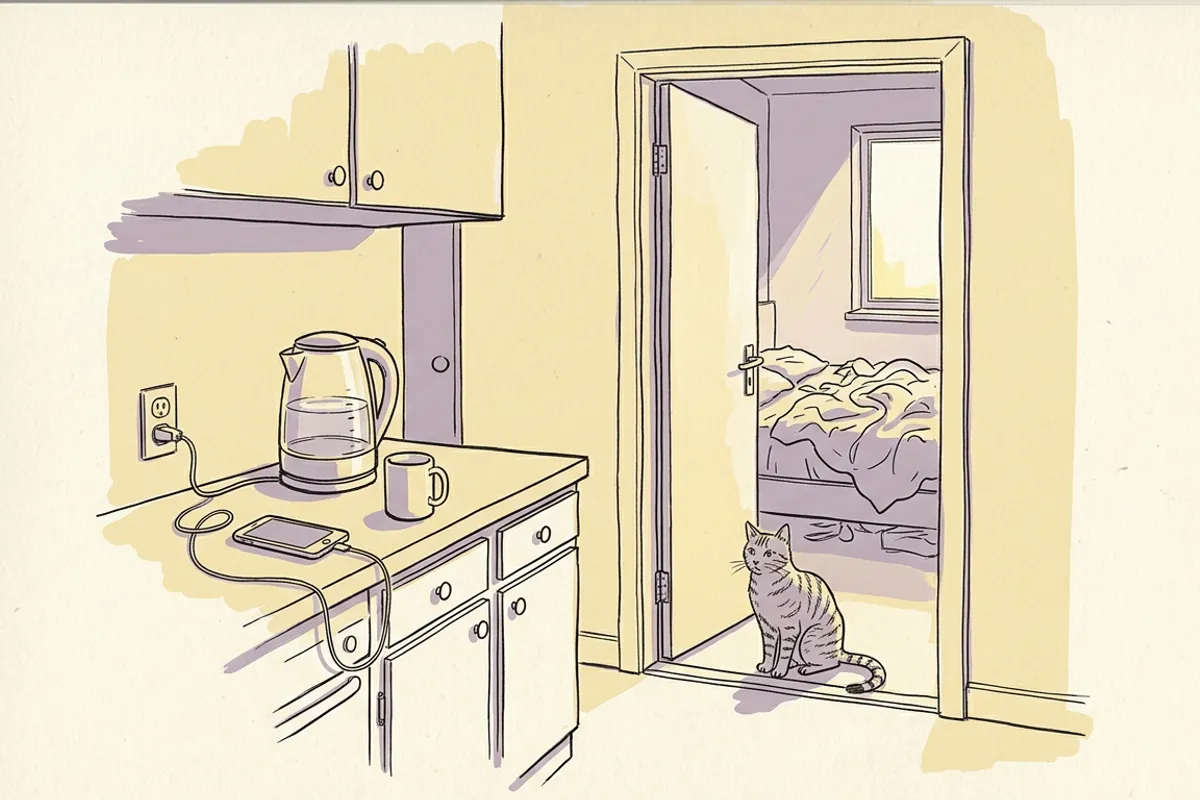
It does fail, though. Across the room worked for me for a while. Then I learned to get up, turn it off and walk back to bed without ever quite waking. Distance is not enough if the path is short and the bed is warm.
What held:
- The alarm outside the bedroom, far enough that I had to open the door. Hallway air is cooler, and cold makes a surprisingly good argument.
- The phone charging on the kitchen counter, with the kettle filled the night before. Turning off the alarm and putting the kettle on became the same trip.
- A wake-up light, which brightens slowly before the alarm, usually over 20 to 40 minutes depending on the model. Philips and Hatch both make them.
The evidence on wake-up lights is thin. In a study from the University of Groningen (Gimenez and colleagues, Chronobiology International, 2010), people woken by an artificial dawn rated themselves less sleepy afterward. That is about how you feel once awake, not whether you wake at all. For me the light helped in winter and did nothing in summer, when the sun was already doing its job.
Clocky is the novelty version of placement: a clock on wheels that rolls off the nightstand and wanders off when the alarm goes. It works, in the sense that you have to chase it. It also bangs into furniture, and on thick carpet it may not get far. I found it funny for a week and then irritating. A week was also about how long my sleeping brain needed to learn where it usually ended up.
If someone else sleeps near you, a wrist vibration plus an alarm outside the room is kinder to them than a 113 decibel clock by the pillow.
Why you might be hard to wake in the first place
Some people really are harder to wake than others, and there is no neat home test for it. But a lot of heavy sleeping comes down to timing and sleep debt, and you can change both.
Sleep runs in cycles of roughly 90 minutes, and yours may be 70 or 110. Carskadon and Dement lay out the stages in Principles and Practice of Sleep Medicine. Deep sleep, the stage where it takes the most noise to wake you, is packed mostly into the early cycles. An alarm that lands in a deep stretch has a much harder job than one that lands near the end of a cycle, when sleep is lighter. Counting cycles is a rule of thumb, not a guarantee, but it explains why a 5:45 a.m. alarm can feel impossible and a 6:15 a.m. one merely bad.
The sleep calculator counts back from your wake time so the alarm lands near a cycle boundary. If you want the arithmetic spelled out, what time should I go to bed walks through it.
Sleep debt is the other half. When you are short on sleep, your body takes extra deep sleep the next chance it gets, and deep sleep is the hardest stage to wake from. In my spreadsheet, the mornings I slept through came almost always after a run of short nights. The sleep debt calculator adds up what you owe. A louder alarm will not fix a week of five-hour nights. It only makes the failure noisier.
If you sleep through alarms that wake everyone else, or wake exhausted after what should have been enough sleep, talk to a doctor, and my about page says plainly what I am and am not.
The setup I would try tonight
If you are starting from one phone alarm you keep sleeping through, this is the order I would go in. It starts with the cheapest fix, and it changes one thing at a time so you can tell what worked.
- Switch to a low, buzzy tone. If you like, add a melodic alarm five minutes earlier.
- Move the phone out of reach, ideally out of the bedroom, and charge it there.
- Add vibration: the watch alarm you may already own, or a bed shaker if you don't.
- Add a mission only if you catch yourself turning alarms off in your sleep.
- Set your bedtime so the alarm lands near the end of a cycle, and keep an eye on your sleep debt.
Write down which mornings worked. Two weeks of notes will tell you more than any product page.
Tonight, open the sleep calculator, put in the time you have to be up, and pick the bedtime that fits. Then carry your phone to the far side of the bedroom door before you get into bed.