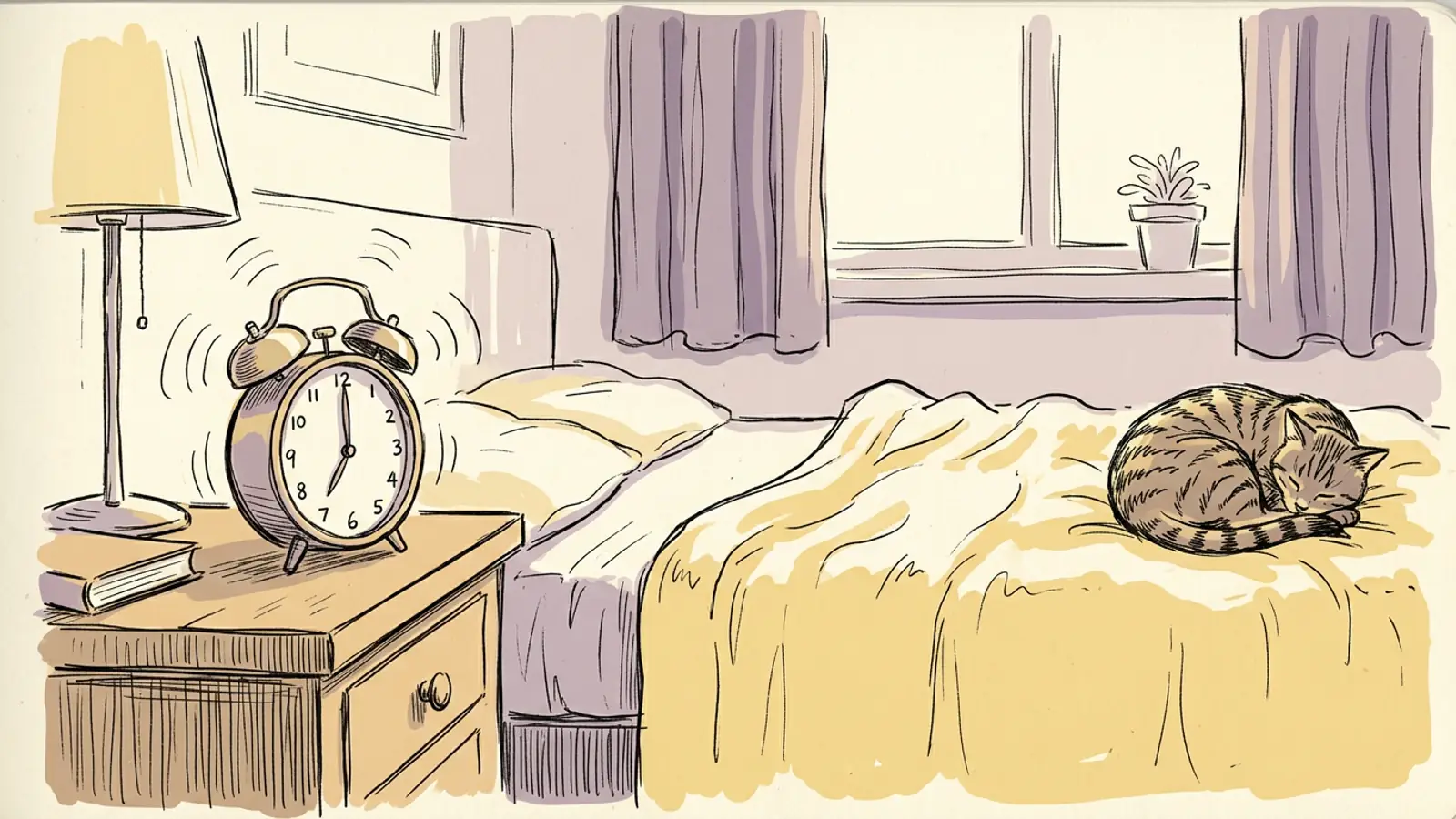
For about four years I thought the fix for sleeping through my alarm was a loud alarm, and when that failed, a louder one. I was on warehouse nights then, in bed by 7:30 a.m., and the alarm at 2:30 p.m. had to haul me out of whatever sleep I had managed by then. I bought a clock the size of a toaster whose box promised a volume I never measured and will not repeat. It worked for nine days. On the tenth I woke at 4:10 p.m. with it still going on the dresser and no memory of it starting.
That afternoon is roughly where my spreadsheet began. It is also why I get wary when advice about waking up starts and ends with volume. Volume matters. It is one dial out of several, though, and the others turned out to matter as much: how deep you are when the sound arrives, what the sound is, and whether your brain has heard it too many times already.
Why a louder alarm stopped working on me
I have a better guess now about those nine days, and it is not that my ears got worse.
Your brain keeps listening while you sleep. It samples sound all night and decides, without consulting you, whether each one is worth waking for. A noise that turns up every day, in the same room, and is never followed by anything that matters gets filed as background. The word for this is habituation, which in plain terms means getting so used to something that you stop reacting to it. The fridge, a ticking radiator, traffic under the window. And, it turns out, an alarm you have heard on 200 mornings in a row.
One of the oldest demonstrations that the sleeping brain sorts sound by meaning comes from Ian Oswald, Anne Taylor and Michel Treisman, published in the journal Brain in 1960. They played lists of names to sleeping volunteers. People responded more to their own name than to other names at the same volume. It was a small study with 1960 equipment, but later work with brain recordings found much the same thing.
So a louder version of a sound your brain has already decided is boring is still a boring sound. My guess is that the extra volume only buys a few more days before the filter catches up. That is my experience plus a reasonable reading of the research, not a measured fact, and I would rather say so.
What decides whether a sound wakes you
Loudness gets the attention because it is the setting you can see. These are the other things doing the work.
How deep you are when it rings
Sleep runs in cycles of roughly 90 minutes, and yours may be 70 or 110. Carskadon and Dement lay this out in Principles and Practice of Sleep Medicine. The cycles early in the night hold more deep sleep, the slow, heavy stage where you are hardest to rouse, and the later cycles hold more of the lighter stages and dreaming sleep.
Sleep researchers talk about an arousal threshold, meaning how much sound it takes to wake you. Rechtschaffen, Hauri and Zeitlin measured it across the stages in a 1966 paper in Perceptual and Motor Skills, and the broad pattern has been repeated many times since. The threshold is highest in deep sleep. An alarm that lands in the middle of a deep stretch has to be much louder to do the same job as one that lands near the end of a cycle.
You cannot know which stage you will be in at 6:30 a.m. You can make a decent guess by counting cycles backwards from it, which is exactly what the sleep calculator does.
Whether the sound is new, and whether it changes
This is the habituation problem from above, and I would put it second only to timing. A sound you have not heard in months gets past the filter more easily than the one you have woken to all year.
The same logic seems to apply within a single morning. A sound that repeats the same two notes for five minutes gives your brain five minutes to get used to it. A sound that shifts in pitch or pattern keeps asking the question again. I have not found a study that tests this on morning alarms, so treat it as a rule of thumb that follows from the habituation work, not as a finding.
What the sound actually is
Pitch, and whether it sounds like music or like a smoke alarm. Both have better evidence behind them than I expected, so they get their own sections.
The low buzz that woke more sleepers
Dorothy Bruck and her colleagues at Victoria University in Melbourne spent years on a grim question: why do some people sleep through smoke alarms? Most household smoke alarms beep at a high pitch of around 3,000 hertz. Hertz counts vibrations per second, and lower numbers sound deeper.
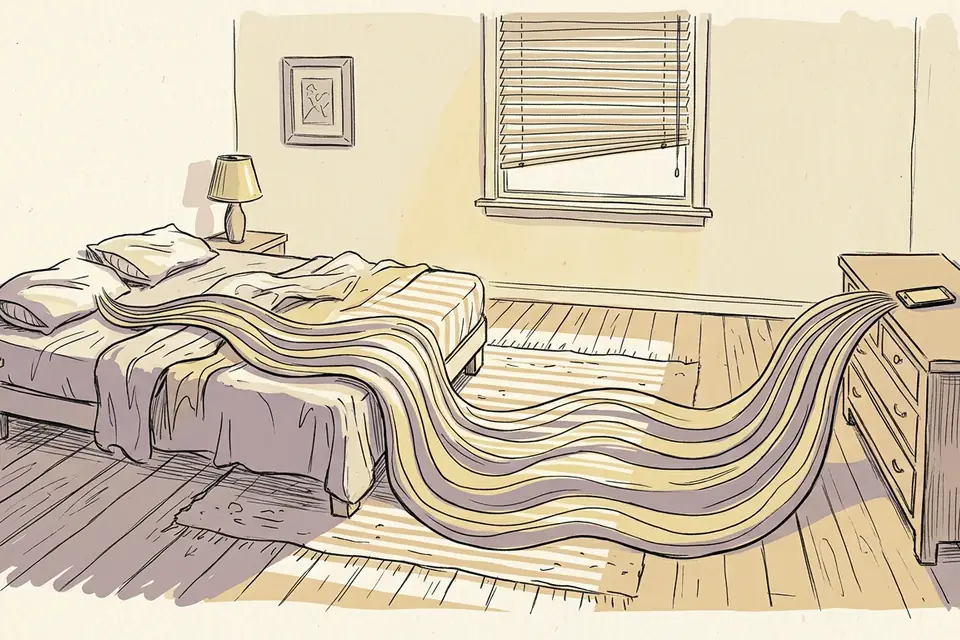
Across a series of studies, her group played different signals to sleeping adults and raised the volume in steps until each person woke. The result that stuck was that a 520 hertz square wave, which is a low, rough, buzzing tone, woke people at lower volumes than the high beep did. In a 2009 paper in the Journal of Sleep Research, Bruck, Ball, Thomas and Rouillard ran nine signals against each other during deep sleep, and the low square waves at 520 and 400 hertz beat the whoops, the white noise and the higher tones. Related work from the same group found the low tone also did better for people who had been drinking and for people who are hard of hearing. The American fire alarm code later adopted that low tone for sleeping rooms in some cases.
The groups were small, and the studies were about smoke alarms at night, not phone alarms in the morning. But the underlying question is the one I was asking at 4:10 that afternoon. What gets through to a brain that does not want to wake up?
What I took from it is that the thin, bright chirp most phones use by default is probably not the most waking pitch. A lower, rougher alarm ringtone may do better. There is one catch. Small phone speakers are weak at low pitches, so a deep sound can come out quieter than the chirp at the same setting. Play it from where your head will be before you trust it.
Beeping, melody and a volume that climbs
Melody versus beeping
In 2020 Stuart McFarlane and colleagues at RMIT University in Melbourne published a survey in PLOS ONE. They asked 50 people what they woke to and how groggy they felt afterwards. The people who woke to sounds they rated as melodic reported less grogginess than the people whose alarm had no melody to it, and standard beeps sat at the unmelodic end of their scale.
Grogginess has a name, sleep inertia, which is the slow, foggy stretch after waking when your head has not caught up with your body. Patricia Tassi and Alain Muzet reviewed it in Sleep Medicine Reviews in 2000. It usually fades within about 30 minutes and can run longer.
Fifty people describing their own mornings is thin. It cannot show that the melody caused the better mornings. Still, it points the opposite way from the smoke alarm work, and I think that is worth noticing. The harsh low buzz may be better at getting you awake. A melody may be kinder once you are.
Rising volume
I tried a gradually rising alarm for most of a month and logged it. I slept through the quiet start and woke to the loud end, feeling as jolted as ever and several minutes later than planned. My best explanation is that the soft opening gave my brain time to file the sound as background before it got loud. That is one person and a spreadsheet, and it may suit a light sleeper far better than it suited me.
I looked for solid research on rising alarms and did not find much. If you have heard that a gentle climb is proven to be better, I have not seen the study that proves it.
Being blasted awake feels awful too. I cannot point you to research showing it harms a healthy person, so I will not claim it does.
When louder helps and when it backfires
Louder is the right fix when the alarm genuinely cannot be heard. The phone is in a bag, a fan is running, you sleep in earplugs, or the alarm sits across the room on purpose. If you lie where you sleep and the sound is faint, turn it up. That part is simple.
It backfires in a few ways.
- It does not fix short sleep. If you are several hours down on the week, the loudest alarm sound you can find is shouting at a brain that needs the sleep. I wrote about checking that first in can't wake up in the morning.
- It does not get you out of bed. A loud alarm gets your hand to the snooze button faster, and then you are back under. That problem has its own fixes, which I cover in how to stop snoozing.
- Very loud clocks close to your ear are not free. The US workplace guideline from NIOSH sets 85 decibels over eight hours as the limit and halves the allowed time for every 3 decibels above that, which leaves about 15 minutes a day at 100. A minute of alarm is well under that. Some extra loud clocks advertise more than 100 decibels, though, and I would not keep one on the pillow and snooze it ten times.
If you routinely sleep through sounds that wake everyone else in the building, or you wake exhausted no matter how long you slept, talk to a doctor; I am not one, and I say more about what I am on my about page.
How I set my alarm now
This is the routine that came out of the spreadsheet. None of it involves the toaster clock, which went to a thrift store.
- I pick the wake time first and count back in cycles with the sleep calculator, so the alarm lands near the end of one.
- I use a lower, rougher sound, not the phone's default chirp, and I tested it from the pillow before I trusted it.
- I set the volume so it is clearly loud from where I sleep. Not maximum.
- I change the sound every two to three weeks, or sooner when I notice I have started sleeping through it. That interval comes from my own log, not from a study.
- The phone sits across the room, so turning it off means standing up. More on why that worked for me in why do I sleep through my alarm.
Tonight, pick a sound you have not used in months, a low one if your speaker can manage it, and play it once from where your head will be. If you would rather the alarm came with a small math problem before it stops, the online alarm clock runs in a browser tab and does that. Then set it for a time the sleep calculator agrees with, and see whether tomorrow is the morning it gets through.