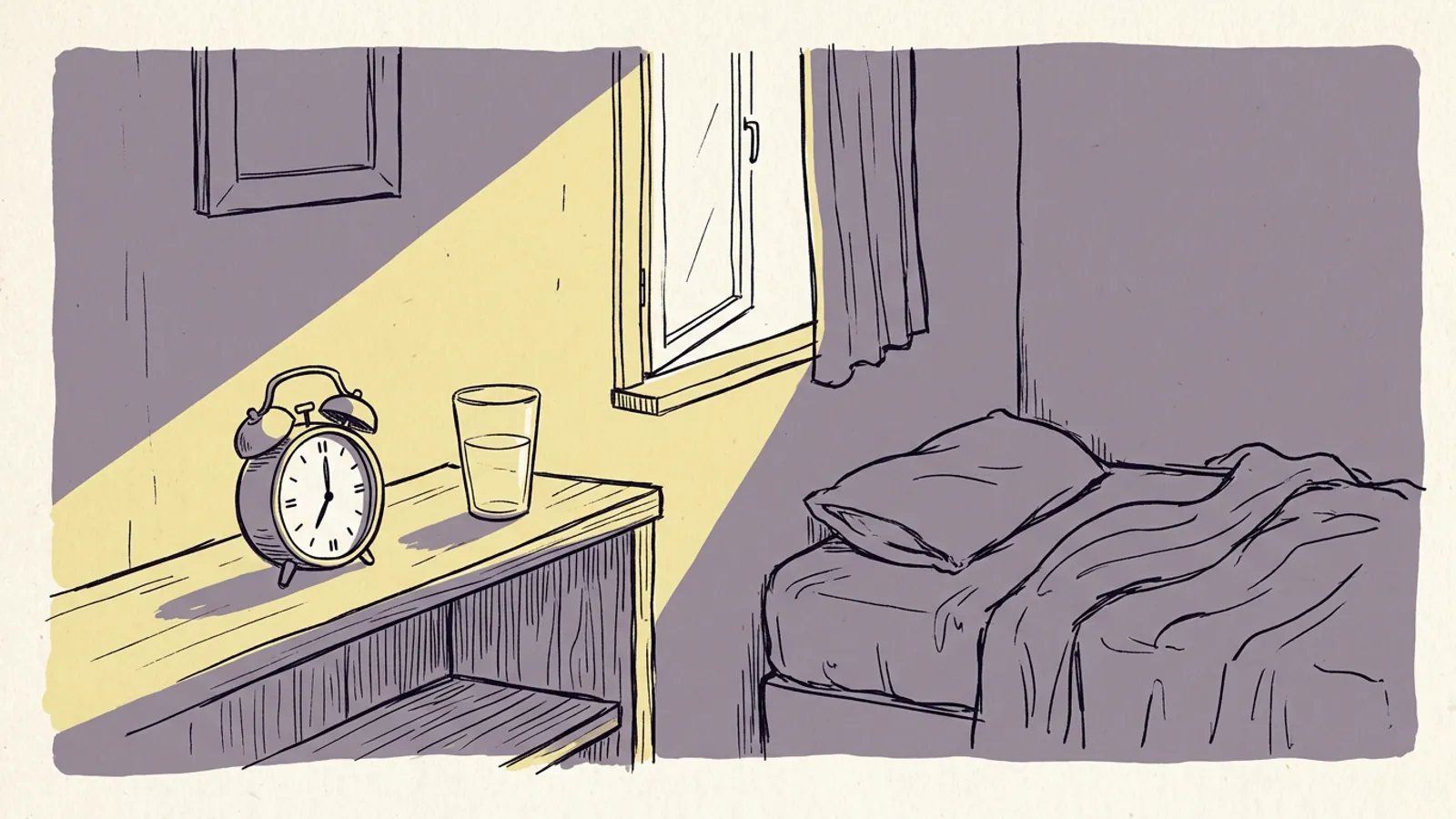
The winter I worked nights on a hospital switchboard, my alarm went off at 1:30 in the afternoon and I hit snooze nine times before I sat up. Nine. I know because one day I counted, out of a sort of horrified curiosity, and worked out that I was spending well over an hour lying in a warm bed not sleeping and not getting up. If you are looking up how to stop snoozing, I will skip the part where someone tells you to try harder. Trying harder was the one thing I did every single day, and it made no difference. What changed things was treating the snooze button as two problems. One is a habit. The other is an alarm going off at a bad moment in your sleep. They need different fixes.
Why do I snooze when I know I will regret it
The snooze button is close to a textbook habit loop. There is a cue, the alarm. There is a routine, your hand finding the phone. And there is a reward that arrives instantly: the noise stops and the bed stays warm for nine more minutes.
The cost arrives much later. You are rushing at 7:40, skipping breakfast, and by then your brain has long since stopped connecting the rush to the button. A reward in one second beats a penalty in forty minutes nearly every time, which is why the habit feels so stubborn.
You are in large company. Mattingly and colleagues, in a 2022 paper in the journal Sleep, asked 450 people about their mornings, and 257 of them, about 57 percent, said they were snoozers. The same study describes how the habit is usually set up. Snoozers tended to keep their alarms within arm's reach, many used alarms spaced evenly a few minutes apart, and they took significantly longer to get out of bed. That describes the habit rather than testing a cure, but it reads like a list of parts, and parts can be moved.
There is a second thing working against you. The version of you that reaches for the button is barely awake. Researchers call this sleep inertia, which in plain words is the heavy, slow fog in the first minutes after waking, when your thinking is worse than it will be an hour later. Hilditch and McHill reviewed the research in Nature and Science of Sleep in 2019. Most of the fog lifts within about 30 minutes, but full recovery does not appear complete until at least an hour after waking.
So the decision about snoozing gets made by the least capable version of you, at the moment the reward is biggest. I spent months arguing with that version of myself at 1:30 p.m. and lost every argument. The better move is to set the room up the night before, so that version cannot finish the loop.
What the research says about the snooze button
A lot of advice online treats snoozing as if it poisons your whole day. The evidence is more split than that, and I would rather tell you so than pick whichever side makes a tidier article.
The most careful look I have found is by Tina Sundelin and colleagues in the Journal of Sleep Research in 2023. Their survey took in 1,732 people, as Stockholm University's write-up of the work reported, and found snoozing widespread, especially in younger people and in later chronotypes, meaning people whose body clock runs late. Then 31 regular snoozers spent two nights in a sleep lab. One morning they were allowed 30 minutes of snoozing, and the other morning they had to get up at once.
The results were mild. Snoozing cost about six minutes of sleep, and it kept people from being woken out of the deepest stage of sleep. On thinking tests, 30 minutes of snoozing either improved performance or made no difference. The authors found no clear effect on morning sleepiness, mood, the stress hormone response on waking, or the overall shape of the night's sleep.
The team was careful about who that applies to. Everyone in the lab was a regular snoozer who finds it easy to fall back asleep after each alarm. In the university's own words, snoozing is most likely not for everyone.
A smaller study points the other way. Ogawa and colleagues, in the Journal of Physiological Anthropology in 2022, compared the two in a lab with 10 students and found that snoozing prolongs sleep inertia compared with a single alarm. They put it down to repeated forced awakenings. Every ring drags you partway up and then lets you sink again.
Here is how I read it. A set half hour of snoozing, falling straight back asleep each time and still leaving on time, is probably not wrecking you. My nine presses were something else. They were more than an hour of broken, shallow dozing that I could have spent actually asleep, if I had set the alarm for when I really needed to get up. If your snooze routine is one press, you may not need any of this. If it is five, you are trading real sleep for bad sleep and paying for it with a rushed morning.
Set one alarm, and put it across the room
Here is what I tried before anything worked, roughly in order.
- A louder alarm. I slept through it, then got used to it, which I wrote about in why a loud alarm stopped waking me.
- Two alarms, ten minutes apart. I learned to snooze both, which is a skill nobody should have.
- Setting the alarm earlier to leave room for snoozing. That turned an accidental snooze into a planned one, and the planned one grew.
- The phone on a shelf across the room. This half worked. I got up, turned it off, and walked straight back to bed.
The one that held was a single alarm across the room with a task attached to turning it off. One alarm matters more than it sounds. The moment you set a backup, part of your brain files the first one as optional, and you have built a snooze button out of two clocks. If your clock or phone lets you switch the snooze function off entirely, do that too.
Across the room means you have to stand up and take a few steps. Not an arm's reach from the bed, and not on the nightstand turned face down. Put it somewhere you have to walk to but can still hear, ideally near the light switch or the curtains, so that silencing it puts light in your eyes too.
The task is what stopped my walk back to bed. I use the online alarm clock on the site for this, because it can ask you to solve a small math problem before it goes quiet. Doing arithmetic while standing up is enough to push past the worst of the fog, and I wrote about why in why a math alarm clock works. It is not magic. On a bad day you can still solve it and crawl back under the covers, which is why the next two sections matter.
I should say plainly that, as far as I can find, nobody has tested the across-the-room trick as a fix in a controlled study. The Mattingly paper only tells us that snoozers keep their alarms close. This is what worked for me, and it has kept working. If ordinary alarms do not reach you at all, my piece on alarm clocks for heavy sleepers has the longer version.
Make the first alarm land on a light patch
Some mornings the alarm feels like being dragged up from the bottom of a lake. Other mornings you open your eyes a minute before it goes off. Part of that difference may be where in a sleep cycle the alarm catches you.
Sleep runs in cycles of roughly 90 minutes, and yours may be 70 or 110. That figure comes from the chapter by Mary Carskadon and William Dement in Principles and Practice of Sleep Medicine, and I went into the spread in the 90 minute sleep cycle is an average. Each cycle moves from light sleep into deep sleep and back up again. The deep stretches are longest in the first half of the night, and by morning more of each cycle is lighter sleep and dreaming, with a patch near the top of each one where you are close to waking anyway.
An alarm that lands on one of those light patches is easier to obey. An alarm that lands in the middle of a cycle is the one that gets snoozed.
The arithmetic is simple, and it is the part of my spreadsheet I still use every night. Start from the time you have to be up and count back in whole cycles, then add about 15 minutes for falling asleep. That 15 minutes is a rule of thumb for how long it takes to fall asleep once the light is off, and yours may be shorter or longer.
- Up at 6:30 a.m. with five cycles, 7 h 30 min: lights off by 10:45 p.m.
- Up at 6:30 a.m. with six cycles, 9 h: lights off by 9:15 p.m.
- Up at 6:30 a.m. with four cycles, 6 h: lights off by 12:15 a.m., which is short for most adults.
The National Sleep Foundation panel (Hirshkowitz and colleagues, Sleep Health, 2015) recommends 7 to 9 hours for adults, so five or six cycles is the target for most people. The sleep calculator does this counting for you and gives you four bedtimes to choose from. I wrote up the reasoning at more length, including how far to trust it, in What time should I go to bed? if you want the longer version.
Be honest with yourself about the limits. Cycles stretch and shrink across the night and from one night to the next, so this raises your odds of a light landing rather than guaranteeing one. Even gadgets that track your sleep stage have not shown they do better. Campanella and colleagues, in Clocks & Sleep in 2024, tested a bedroom alarm that fired on sleep stage against an ordinary alarm in 29 adults over four nights, and found no significant difference on any of their attention test measures. A calculator works from an average, which is cruder still. For me it was still the difference between an alarm I fought and an alarm I could live with, and I treat the bedtime it gives me as a good bet, not a promise.
Give the groggy minute a new routine
A habit loop does not disappear when you take away the routine. It looks for another one. If the only thing you change is where the alarm sits, the groggy version of you will invent a new way back to bed. So give that minute something specific to do instead.
Mine is short. Feet on the floor, walk to the alarm, turn it off, turn on the main light, drink the glass of water I left next to it the night before, and leave the bedroom. I do not decide anything until I am standing in the kitchen. Any debate about ten more minutes waits until I am two rooms away from the bed, and by then the answer is obvious.
The light is the step with a study behind it. Hilditch and colleagues, in the Journal of Sleep Research in 2022, woke 12 people out of deep sleep under either bluish-white, daylight-like light or dim red light. Under the bluish light people had fewer lapses of attention, felt more alert and reported better mood. Twelve people is a small study, and the authors only say it may help. But a clock next to the light switch cost me nothing.
Keep a reward in the loop too, because the snooze button was rewarding you and you are taking that away. It can be small. The first coffee, or a song you only play in the morning. The point is that getting up gets you something good within a minute, the way snoozing did. I wrote up the rest of that first stretch out of bed in how to get out of bed.
Then give it time. In a study by Phillippa Lally and colleagues in the European Journal of Social Psychology in 2009, volunteers picked one new daily behavior and tracked how automatic it felt. The median time to reach automatic was 66 days, and the spread ran from 18 to 254. Missing a single day did not knock people back to the start.
I found that last part the most useful. I had a column in the spreadsheet for "got up on the first alarm", and the week it had three blanks in it I nearly gave up. It was fine. The column filled in eventually.
When snoozing is telling you something else
Sometimes the alarm is not the problem. If you are sleeping five hours a night on weekdays, no alarm placement will make 6:30 a.m. feel good, because your body is doing exactly what it should with too little sleep. Snoozing is often just the most visible sign of a short week.
Promises made at night will not cover that either. I would lie down fully intending to spring up at the first ring, and the person who heard the ring was not the person who had made the promise. Resolve at 11 p.m. does not reach 6:30 a.m.
Add up what you actually slept over the last seven nights with the sleep debt calculator. If the number is large, an earlier bedtime will do more for your mornings than anything else on this page, and the counting above tells you which earlier bedtime to pick.
If you are getting a full night and still cannot wake, or you feel worn out all day no matter what you change, please talk to a doctor, and you can read what I am and am not on my about page.
What to try tonight
You do not need to fix everything at once. Pick your wake time for tomorrow and run it through the sleep calculator, then choose the bedtime that gives you five or six cycles. Delete any backup alarms, and turn the snooze function off if you can. Move the one alarm that is left to the far side of the room, next to the light switch, and put a glass of water beside it.
Tomorrow, when it goes off, your only job is to stand up, walk to it and turn the light on. Everything else can wait until you are in the kitchen.