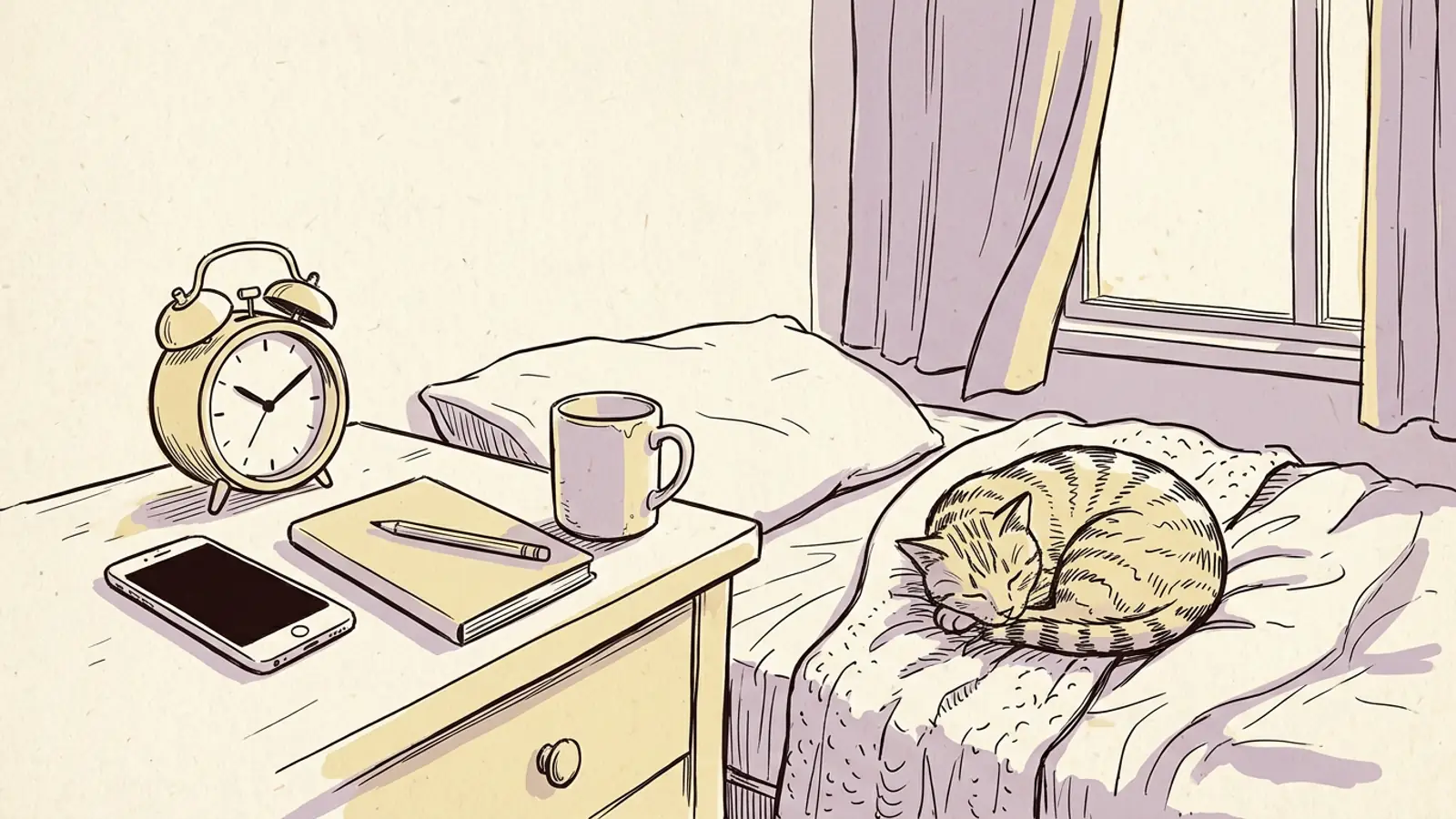
A math alarm clock sounds like a prank you would play on someone you dislike. The alarm goes off, and before it stops you have to tell it what 47 plus 38 is. I rolled my eyes at the idea for a long time. Then I tried one during the worst stretch of mornings I have ever had, and I have kept some version of it since. This is why a problem you have to solve works on a brain that is barely awake, and where it stops working.
Why the snooze button wins in the first minute
Hitting snooze is not really a decision, and that is the whole trouble with it. By the hundredth morning your hand knows where the button is and does the job without checking with anyone upstairs. I wrote about that habit in how to stop snoozing. The short version is that a movement you repeat every day, half conscious, gets stored as a routine, and routines run on very little brain.
An ordinary alarm asks for exactly that kind of movement. One tap, one swipe, one button in the dark. A reflex can do it. So the alarm that is supposed to wake you gets switched off by the part of you that is still asleep, and you find out what happened at 7:50 a.m.
Putting the phone across the room is the usual fix, and it helps some people. It did not help me for long. I learned to walk over, silence it and walk back to bed with my eyes mostly shut. Walking is a routine too.
What a half-asleep brain can and cannot do
The slow, foggy, stupid feeling of the first minutes after waking has a name, sleep inertia. It is the gap between your eyes opening and your thinking coming back.
The clearest picture of it I have found comes from Balkin and colleagues, in the journal Brain in 2002. They used PET scans, which show where blood is flowing in the brain, on people as they woke up. Blood flow came back first to the brainstem and thalamus, the deep parts that handle basic arousal. The front of the brain was slower. Over the next 15 minutes or so the increases showed up mainly in the front regions of the cortex, which is where planning, judging and holding a number in your head get done, and people did not feel properly alert until 20 to 30 minutes after waking.
So for those first minutes you have a body that can move and a brain that cannot reason very well yet. That is exactly the combination that hits snooze.
How bad is the reasoning? Wertz and colleagues, writing in JAMA in 2006, woke people and tested them right away on simple arithmetic. In the first few minutes after waking, people did worse than the same people after 26 hours without sleep. The worst of it cleared within about ten minutes. Traces of it showed up for about two hours.
A review by Hilditch and McHill in Nature and Science of Sleep in 2019 says most of the recovery happens in the first 15 to 30 minutes, but some of it can take an hour or more. It is heavier when you are short on sleep. The studies point both ways on whether waking from deep sleep makes it worse. Treat those numbers as a typical range, not a stopwatch. Yours may be shorter, or a lot longer.
Why a math problem pulls you the rest of the way up
People tend to get this part backwards. A math alarm does not work because your sleepy brain is good at sums. It works because your sleepy brain is bad at them.
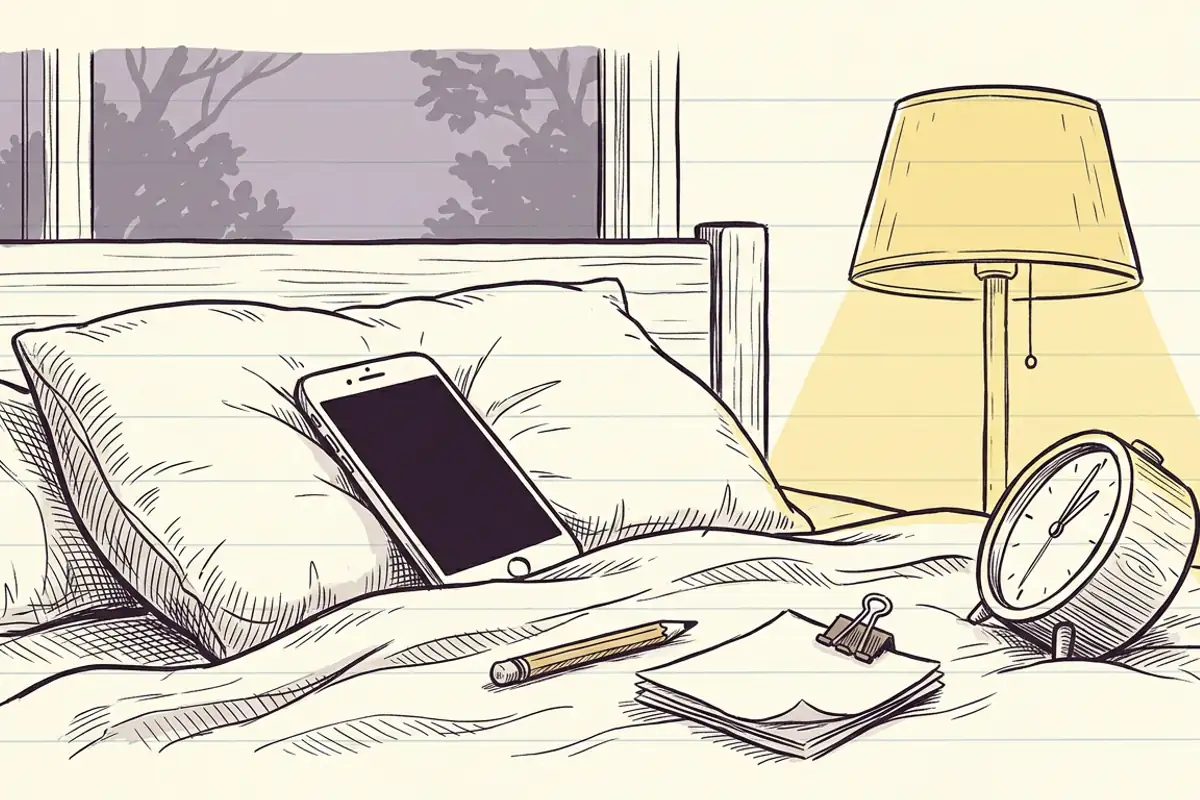
To answer 47 plus 38 you have to hold two numbers, carry a one and check the result. That uses working memory, the short-term notepad at the front of the brain, which is the same region Balkin's scans showed coming back last. A reflex cannot do sums. The only way to stop the noise is to drag the slow part of you into the room.
The effort itself seems to help. You look at a screen, read the digits, get one wrong and try again, and the alarm keeps ringing the whole time. Getting the answer right takes anywhere from 30 seconds to a couple of minutes of something your hand could never do alone. That is only a small slice of sleep inertia. It is also the slice where the snooze decision gets made.
I want to be straight about the evidence. I have not found a proper trial that puts math alarms up against ordinary alarms and counts who actually gets up. What exists is the research on sleep inertia and on how thinking returns after waking, and the math alarm idea follows from it. That is a good reason to try one. It does not prove it will work for you.
I tried it during my late-shift years. I was at the call center then, getting home around 3 a.m. and needing to be up at noon to get errands done before the next shift. I put a math alarm app on an old phone and set it to three problems. The first morning I solved all three, felt oddly proud of myself and climbed back into bed. It turns out you can do sums and still choose sleep. What finally changed things was the other half of the job, which I will come to. The problems woke my head up. They did not decide what I did with it.
How hard the problem should be
There is a sweet spot, and I found both edges of it.
If the problem is too easy, it turns into another routine. After two weeks of 3 plus 4 I was answering with the same lack of thought I had given the snooze button. The brain learns a pattern fast when the pattern never changes.
If it is too hard, you get angry instead of awake. I once set long multiplication. On a bad morning I got it wrong four times, and before the fifth try I took the battery out of the phone. Punishing alarms carry that risk, and it is one of the things I looked at in my piece on Alarmy alternatives.
This is what has held up for me:
- Two-digit addition or subtraction, with a carry or a borrow. It takes real thought but rarely more than one try.
- New random numbers every time, so you cannot memorize the answer.
- One or two problems, not five. The point is to get your head up, not to sit an exam.
- A wrong answer that just gives you a new problem, instead of making the alarm louder.
That is a rule of thumb from my own mornings, not something from a study. If single-digit multiplication wakes you better, use that.
Where a math alarm does not help
A problem only helps once you hear the alarm. If you sleep straight through the sound, and I did that for years, no puzzle can help, because you never get to it. That is a different problem, and I wrote about its causes and what finally worked for me in why do I sleep through my alarm.
A math alarm also does nothing about short sleep. If you get five and a half hours a night during the week, you wake with heavier inertia, and the math is fighting uphill. Can't wake up in the morning shows how to add up that debt first. Often the honest fix is an earlier bedtime, not a smarter alarm.
It also does not plan the next minute for you. The sums wake you up, and what you do right afterward is what keeps you up: feet on the floor, lights on, out of the bedroom. I fill the kettle the night before, so the first thing I do after the last answer is walk to the kitchen. That was the other half of the job on those call center mornings.
If you sleep through every alarm no matter what, or feel drugged for hours most mornings even after enough sleep, talk to a doctor, and the about page says what I am and am not.
Setting up a math alarm tonight
You do not need to install anything to try this. The online alarm clock on this site is a plain alarm that runs in a browser tab, and it can make you solve a math problem to turn it off. Because it lives in a tab, the tab has to stay open, the device has to stay awake and the volume has to be up. Test it once in the evening with the alarm set a couple of minutes ahead, so you have seen the problem before you meet it half asleep.
Then pick the time. An alarm that goes off in the middle of deep sleep is harder to wake from, so the time matters as much as the problem. The sleep calculator counts back from your wake time in cycles. A cycle is roughly 90 minutes, and yours may be 70 or 110. It gives you bedtimes that end near the close of a cycle instead of the middle of one. The cycle figure comes from Carskadon and Dement in Principles and Practice of Sleep Medicine, and it is an average, not a promise.
Here is what I would do tonight:
- Decide on your wake time and run it through the sleep calculator.
- Set the alarm tool for that time with the math problem turned on.
- Put the phone or laptop where you have to sit up to read it.
- Decide now what you will do right after the last answer. Lights on, feet on the floor, kettle.
Give it a week before you judge it. The first morning feels like a trick. By the fourth or fifth morning, if it is working, you will be properly awake by the time you get the answer, and you will not even think about the snooze button.