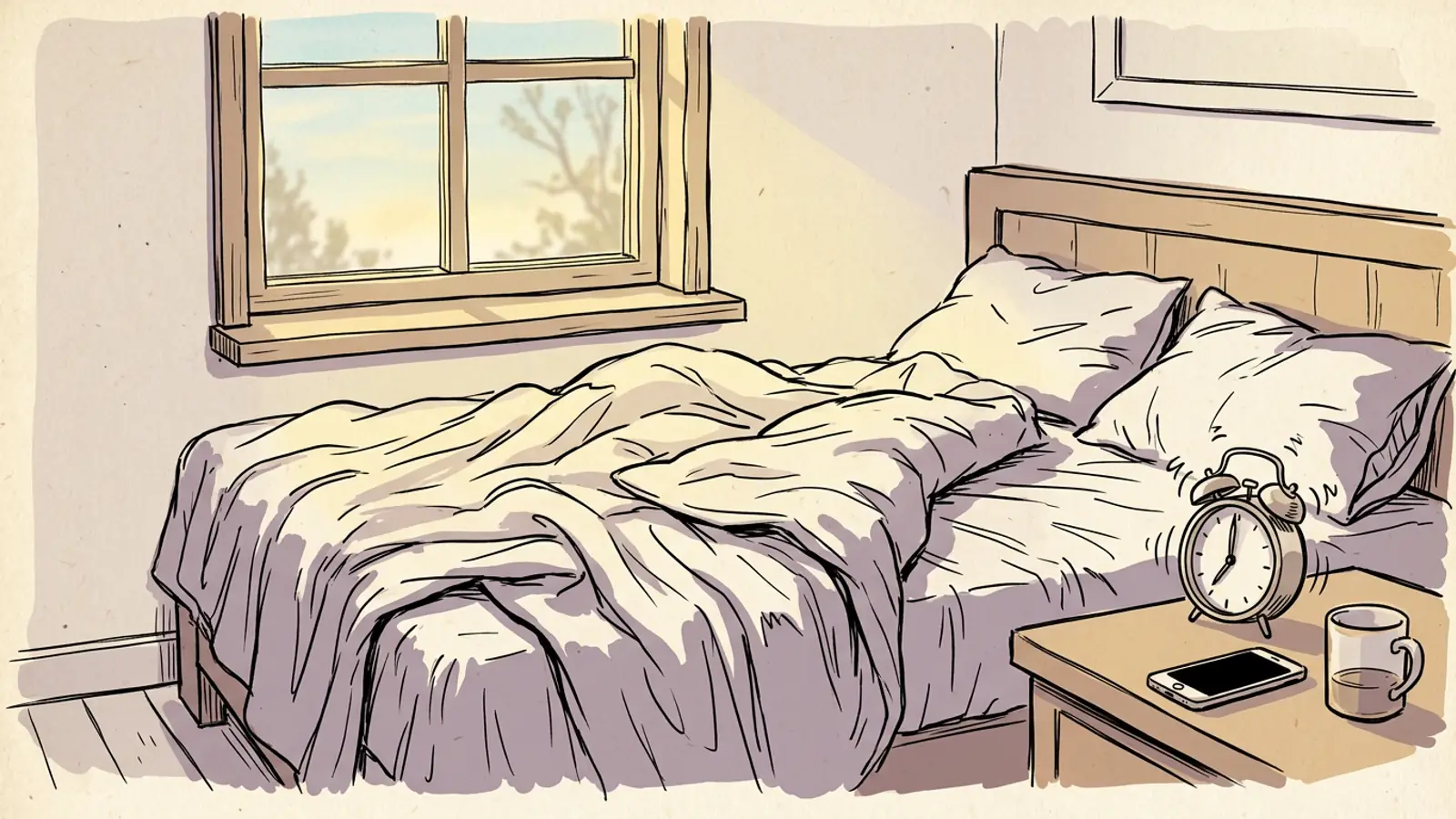
For about six years my honest answer to "why do I sleep through my alarm" was that something in me was broken. I was working rotating late shifts, warehouse nights first, then a hospital switchboard, then a call center that closed at 2 a.m. I slept through alarms so often that I started setting them the way other people buy lottery tickets, hoping one would land. None of the usual fixes held. What finally worked was a spreadsheet, and it only worked because it made me stop blaming the alarm and look at what was going on underneath it.
For most people I have talked to, the answer comes down to the same few things. You are short on sleep. The alarm is going off in the deepest part of a sleep cycle. And your brain has learned that this particular sound can be ignored. Below is what I learned about each one, what I tried that turned out to be a waste of a week, and what actually changed my mornings.
The short answer is usually sleep debt
Sleep debt is the running total of sleep you needed and did not get. It sounds like a figure of speech. It behaves more like a real balance.
The National Sleep Foundation panel (Hirshkowitz et al., Sleep Health, 2015) put the recommended range for adults 18 to 64 at 7 to 9 hours a night. That range covers a whole population. Your own number sits somewhere inside it, or occasionally just outside. When I started logging my nights, I was averaging a little under six hours on work nights and trying to make up for it with one long Sunday.
This matters for the alarm because a body that is behind on sleep spends more of the night in deep sleep, the slow, heavy stage that is hardest to wake from. Researchers talk about the arousal threshold, which just means how much noise it takes to pull you out of sleep. After sleep loss, that threshold goes up.
One of the older experiments on this, by Williams, Hammack, Daly, Dement and Lubin in Electroencephalography and Clinical Neurophysiology in 1964, played tones to sleeping volunteers. After being kept awake, the volunteers responded to the tones less often, and least of all during deep sleep. It was a small study, and it is old. The basic finding, that people short on sleep are harder to wake, has held up since.
The other problem with debt is that you stop feeling it. Van Dongen and colleagues (Sleep, 2003) kept volunteers on six hours a night for two weeks. By the end, their scores on attention tests looked like those of people who had skipped a full night of sleep. Their own ratings of how sleepy they felt had leveled off after the first few days. They were getting worse and did not notice.
That was me. I felt "a bit tired." The spreadsheet said I was down about eight hours by Friday.
If you want your own number, the sleep debt calculator adds up the week for you. It is arithmetic, not a verdict. Your real need might be seven hours or it might be nine, and only a few weeks of honest logging will tell you which.
Your alarm may be going off in deep sleep
Sleep runs in cycles. Carskadon and Dement, in Principles and Practice of Sleep Medicine, describe each cycle as roughly 90 minutes, and yours may be 70 or 110. Each cycle moves from light sleep down into deep sleep and then up into REM, the dreaming stage, before it starts again.
Most deep sleep happens early. The first two or three cycles hold most of it, and each cycle after that has less. By the last part of a full night your cycles are mostly light sleep and REM. For alarms that is good news. After a normal night, a 6:30 a.m. alarm usually catches you at a point you can surface from.
A short night takes that away. Get into bed at 2:30 a.m. for a 6:30 a.m. alarm and, after the usual quarter of an hour to fall asleep, the alarm goes off about two and a half cycles in. That is well inside the part of the night where deep sleep still turns up. Add a week of debt and you get the heaviest sleep of the night at the exact minute you need to hear something.
Even when a deep sleep alarm does wake you, it wakes you badly. The foggy stretch right after waking is called sleep inertia: you are awake enough to reach for the phone but not awake enough to decide anything. Tassi and Muzet reviewed the research in Sleep Medicine Reviews in 2000, and the grogginess is worse when you are woken out of deep sleep. That explains a lot of "sleeping through" an alarm that you did, technically, turn off. You were awake for four seconds and none of them made it into memory.
Counting backwards is how you avoid this. The sleep calculator takes your wake time and gives you bedtimes that end on a cycle boundary, so the alarm doesn't land in the middle of one. I went through the arithmetic in What time should I go to bed? if you want to see how it works. Treat it as a rule of thumb. Cycles vary from person to person and drift across the night, so aim for the neighborhood, not the minute.
Your brain learns to ignore the sound
Your ears keep working while you sleep. Your brain keeps checking incoming sounds and deciding which ones are worth waking up for. Oswald, Taylor and Treisman showed a version of this in Brain in 1960: sleepers reacted more to their own name than to other names played at the same volume. The sleeping brain sorts what it hears.
That sorting cuts both ways. A sound that plays every morning and is followed by nothing bad, because you snooze it and drift off again, gets filed as safe. This is habituation, which means your reaction to a repeated sound shrinks each time it arrives without consequences.
The research here is thinner than I would like. Studies of traffic and aircraft noise, reviewed by Basner and colleagues in The Lancet in 2014, found that people wake less often to a noise they hear every night, even though their heart rate still reacts to it. Those studies were about noise people want to sleep through, not alarms. So the link to alarms is my reading of the research, not something anyone has measured directly.
It matched my experience closely enough. I used the same ringtone for about three years. By the end I could sleep through it at full volume and still wake to a message tone I had switched on the week before.
Snoozing speeds this up. Every tap teaches your brain that the alarm is a suggestion. I wrote a whole piece on how to stop snoozing, because breaking that habit was harder for me than any of the arithmetic.
What I tried that did not work
Here is the list of failures, so you can skip them.
- A louder alarm. It worked for about a week. Then I slept through it just like the old one. Volume helps a little with the arousal threshold, but it does nothing about debt or habituation, and on the mornings I did hear it, it felt like being shouted at.
- Two alarms ten minutes apart. I learned to turn off both. The second alarm just became part of the routine.
- The phone across the room. This is the trick everyone recommends, and it half works. I got up, turned it off, got back into bed, and had no memory of any of it by breakfast.
- Deciding I was a heavy sleeper. For years I believed that was the explanation and the end of the conversation. People really do differ in how much noise it takes to wake them. But I was using the label to avoid looking at my hours, and my hours were the problem.
What actually helped me
Pay down the debt first. None of the alarm tricks lasted until I was sleeping close to my own need on most nights. Once the balance was near zero, my plain old alarm started working again, which felt a little insulting after all the gadgets. Paying back a week of debt takes several nights of earlier bedtimes, not one lie-in, and the sleep debt calculator shows roughly how many.
Time the alarm to a cycle boundary. I count back from the alarm in cycles of about 90 minutes, then add 15 minutes to fall asleep. It is a rule of thumb and I miss sometimes. It still took my bad mornings from most of the week down to a couple a month.
Change the sound, and keep changing it. A new tone every couple of weeks gives habituation less to work with. A study by McFarlane and colleagues in PLOS ONE in 2020 asked people about their alarms and found that people who woke to a melodic sound reported less grogginess than people who woke to a sound they rated as unmelodic. It was a survey of fifty people, so it tells you how they felt rather than what their brains were doing. I switched to a tune anyway, since it cost nothing.
Make the off switch take some thought. This is the fix for sleep inertia. If turning off the alarm takes one swipe, a half-asleep brain can do it. If it takes solving a sum like 23 plus 48, you have to be awake enough to do arithmetic, and by the time you have the answer you are usually awake enough to stay up.
The online alarm clock on this site has that option. Turn on the math problem and the alarm keeps going until you answer. It runs in a browser tab, so keep the tab open, the device plugged in and the volume up. It will not fix sleep debt, and no sum helps if you never hear the alarm in the first place. What it closes is the gap where I used to switch alarms off in my sleep.
When your body clock is working against you
Everything above assumes your alarm goes off during what your body thinks is morning. On rotating shifts, mine often did not.
Your body runs on an internal clock of roughly 24 hours, the circadian rhythm. It is why you feel sleepy at some hours and alert at others, whatever you did the day before. An alarm that goes off at that clock's low point is fighting your biology on top of your sleep stage. For most people on a day schedule, the low point falls in the small hours, not long before a normal wake time.
That is part of why the weeks I rotated from late shifts to early starts were the weeks I missed the most mornings. My clock had not moved yet. So 6:00 a.m. felt like 3:00 a.m., because as far as my body was concerned, it was.
The fix for a regular schedule is dull. Get up at the same time seven days a week, weekends included, so your clock has something to set itself by. I fought this for a long time because weekend lie-ins felt like the only good part of the week. The spreadsheet disagreed. My worst Mondays came right after my longest Sunday mornings.
If you sleep a full night most nights and still sleep through loud alarms, or wake up exhausted no matter how long you slept, talk to a doctor, and you can read what I am and am not on the about page.
Tonight's arithmetic
Before you set anything tonight, put last week into the sleep debt calculator. If it says you are more than a few hours behind, that is probably most of your answer, and this week's plan is earlier nights, not louder mornings.
Then pick tomorrow's wake time and let the sleep calculator give you a bedtime that ends on a cycle. Change your alarm sound to one you have not heard in a month. If you are someone who turns alarms off without waking, set the online alarm clock with the math problem on, leave the tab open, and do not touch the snooze button.
Then write down what happened in the morning. One line is enough. After a week you will have your own pillow math, and it will tell you more than I can.