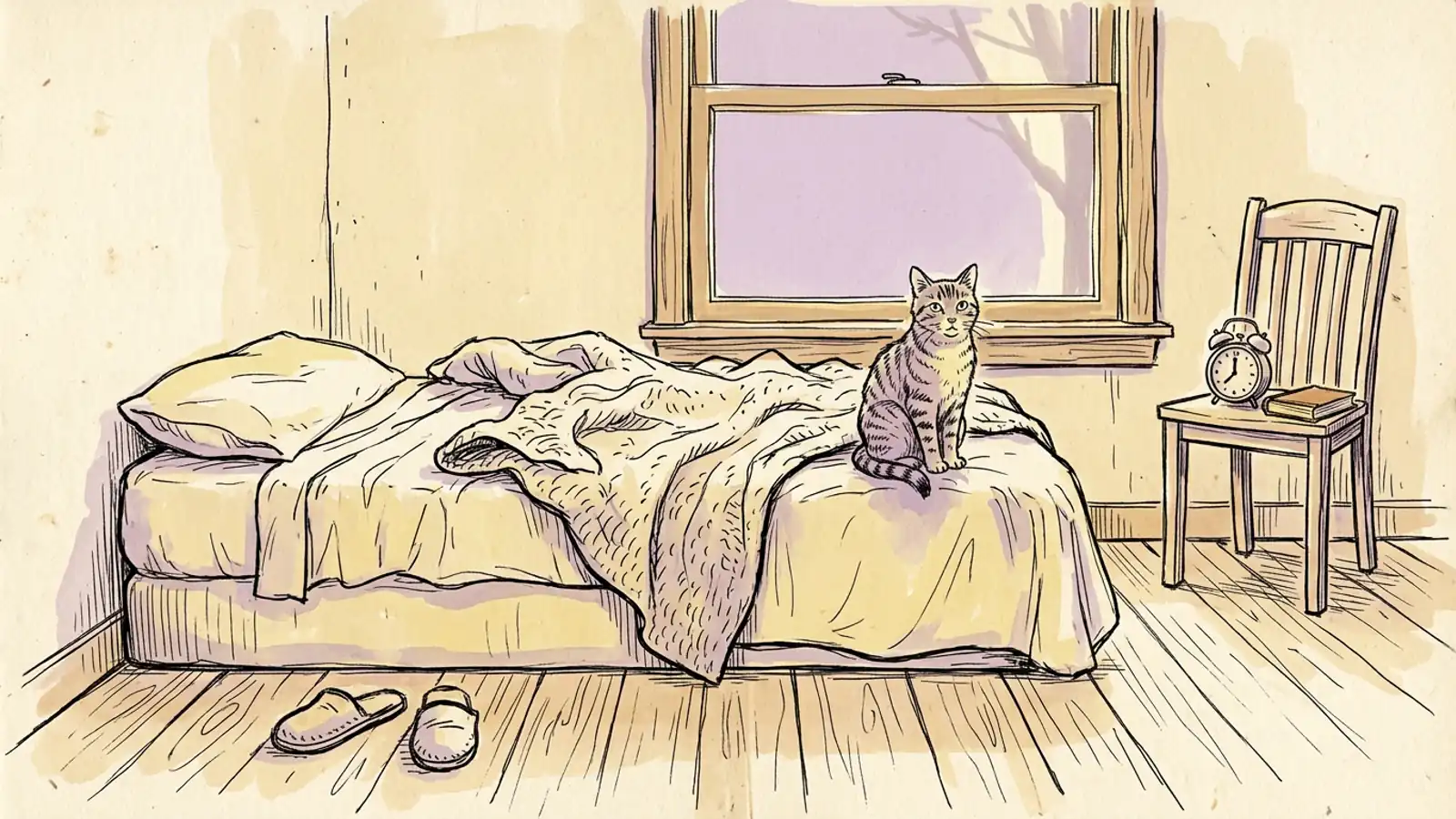
For about a year I believed the hard part of mornings was waking up. It isn't. Waking up happens to you. The hard part is how to get out of bed once you are awake, in that minute when the blanket is warm, the room is dark, and your brain is making a very reasonable case for five more minutes. I lose that argument less often now. Most of the credit goes to a routine that fits inside 90 seconds, and to a cat who does not accept excuses.
Waffles is a tabby with one setting. At 5:40 a.m. she walks the length of my body, stands on my chest, and stares at me. If I roll over, she moves to the pillow and taps my eyelid with one paw. No claws. She has never needed claws. Weekends, holidays, the morning after I got home at 1 a.m., it's the same routine. Eventually I noticed that Waffles never lets me lie there deciding. She forces the first move, and once that move is made, the rest of the morning mostly follows. What follows is how I act as my own Waffles on the days she sleeps in. That has never happened, but you get the idea.
Why the first 90 seconds decide it
My spreadsheet has a column I added years ago called "up by". It records the minutes between the alarm going off and my feet touching the floor. When I started, the column looked like a bad week on the stock market: 2, 34, 9, 51, 3. Almost every row under two minutes was a good morning. The rows over ten were the mornings I ran late, skipped breakfast, and felt worse for all that extra lying there.
That's one person's spreadsheet, so treat it as a story and not a study. The pattern made more sense once I read about what happens in the first minutes after waking. The longer you stay lying down in the dark, the more time the sleepy part of you has to win. Getting up isn't a willpower test you pass once. It's a short window. You use it, or it closes and the negotiating starts.
So everything below aims at one small thing: getting from alarm to standing in about a minute and a half.
What your brain is doing while you lie there
The heavy, slow feeling right after the alarm has a name, sleep inertia. In plain words, it's the lag between your eyes opening and your brain running at daytime speed. It isn't laziness. Everyone goes through it.
Patricia Tassi and Alain Muzet reviewed the research on it in Sleep Medicine Reviews in 2000. Here is the broad picture from that review. Without major sleep loss it rarely lasts more than 30 minutes, though studies have measured anything from a minute to a few hours. It tends to be worse when you are woken out of deep sleep, and worse again when you went to bed short on sleep.
Two things follow from that, and both changed how I get out of bed in the morning.
First, the version of you lying there at 6:30 a.m. is the least qualified person in the house to decide whether to get up. Your judgment is running on low power. A plan that depends on a good decision in that minute will fail on exactly the mornings you need it. So you make the decision the night before, and in the morning you just carry it out.
Second, lying still doesn't make the fog lift faster. If you wait until you feel awake before you get up, you have the order backwards. You get up, and then you start to feel awake.
If you are groggy most mornings, first check whether you are simply short on sleep. I wrote about that in can't wake up in the morning. If you can't get out of bed most mornings however much you sleep, or the heaviness stays with you all day, talk to a doctor, and my about page says plainly what I am and am not.
Light first, before you think
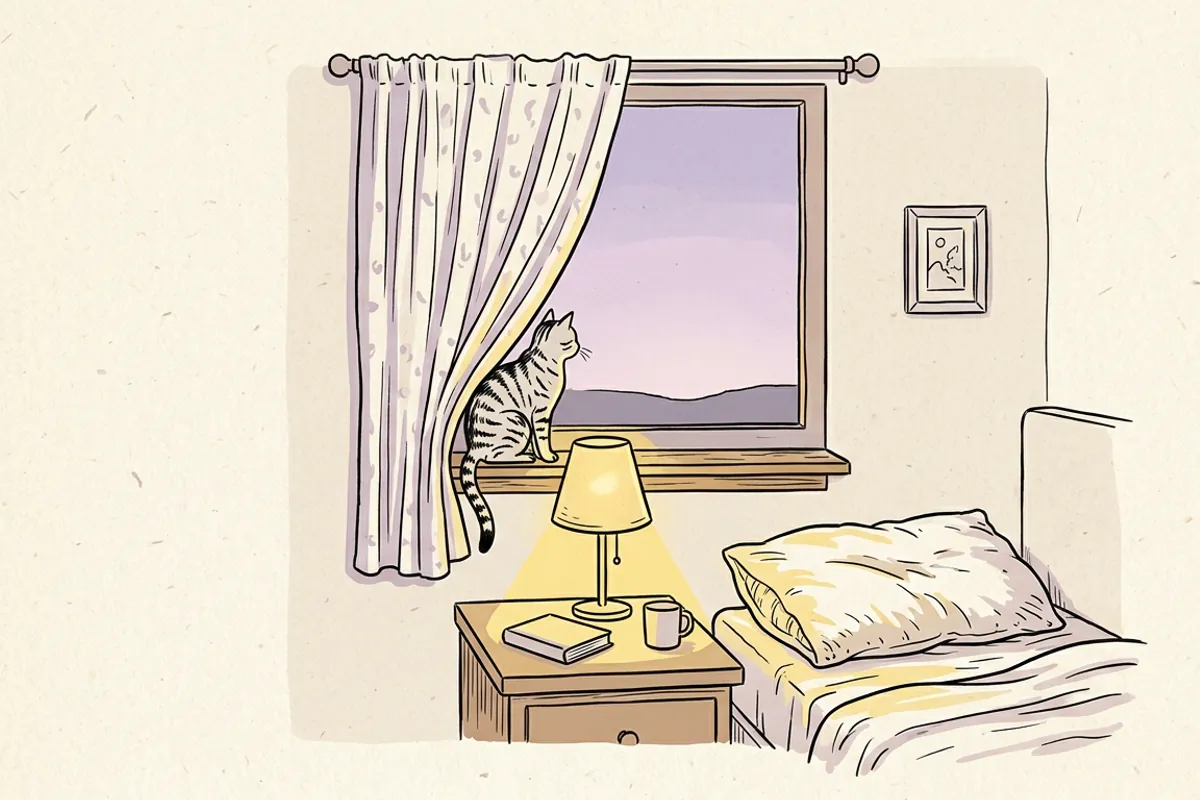
The first thing I do is make the room bright. I don't check my phone. I turn on a light.
The science is decent on the long game and thinner on the short one, so I'll keep them apart. Over days and weeks, morning light moves your body clock earlier. Sat Bir Khalsa and colleagues mapped this in the Journal of Physiology in 2003: bright light in the early morning shifts the clock earlier, and light late in the evening pushes it later. With an earlier clock, your body is already closer to awake when the alarm goes, and each later morning gets a little easier.
The short game is whether light cuts through sleep inertia the moment you switch it on, and that's less settled. Cassie Hilditch, Jillian Dorrian and Siobhan Banks reviewed quick fixes for sleep inertia in Industrial Health in 2016 and found no convincing evidence for any of them. Light and temperature showed promise for feeling more alert, not yet for doing anything better. I believe them. Light has never made me feel clever at 6:30 a.m. What it does is remove the darkness, and the dark is what makes lying back down feel so natural.
Here is what I do, roughly in order:
- A lamp on the nightstand with the switch exactly where my hand lands, so I can turn it on without sitting up.
- Curtains open within the first minute if it's light outside. Daylight through a window, even a gray one, is far brighter than any bulb in my apartment. Lux is the unit a light meter reads. As a rough rule of thumb, an ordinary room light is a few hundred lux, and an overcast sky can be several thousand.
- If it's still dark, which it is for half the year, every overhead light I own goes on.
Your phone doesn't count as the light. I tried it. A phone is a door into ten minutes of scrolling while lying down, and a screen at arm's length is dim next to a ceiling light.
Feet on the floor, then one more move
Waffles taught me this part without meaning to. She doesn't argue with me. She makes me move, and once I have moved, I rarely get back into bed.
So my rule is physical, not mental: feet on the floor before the alarm stops ringing, or a few seconds after.
Put the alarm where you have to stand up to turn it off. Everyone says this, and it does work for the standing part. It doesn't work alone. You can stand, silence an alarm, and walk straight back to bed with your eyes half shut. I did exactly that for years. The alarm across the room gets you on your feet. It doesn't keep you there.
What keeps you there is a second move that takes you away from the bed. Mine goes like this:
- Sit up and put both feet flat on the floor. Don't wait until you feel ready.
- Stand and walk to the alarm on the far side of the room.
- Keep walking to the kitchen and fill the kettle.
- Drink a glass of water while it heats.
The kettle does most of the work. It's a small task that ends with a click, and I have to stand in the kitchen to hear it. When it clicks off, I have been upright for two or three minutes, and going back to bed now feels like more effort than staying up.
Some people swear by splashing cold water on their face. I tried it for a month. It kept me awake for about as long as my face stayed wet. I wouldn't call it useless, but it didn't hold up as a system.
If you want an alarm that asks more of you, the online alarm clock can make you solve a sum before it goes quiet. A sum works like the kettle: your brain does one small, awake thing before it has a chance to drift. I wrote more about why your hand finds the button before you do in how to stop snoozing.
Set up the night before so the morning has less to argue with
The first 90 seconds get easier when you aren't waking from the deepest part of your sleep, and when you aren't already two hours short.
Sleep runs in cycles of roughly 90 minutes, and yours may be 70 or 110. That's the figure Mary Carskadon and William Dement give in Principles and Practice of Sleep Medicine, and it varies between people and across the night. Waking near the end of a cycle, when sleep is lighter, tends to feel better than being dragged out of the middle of one. That's the whole reason I count backwards from the alarm, which I still do every night. The sleep calculator does the arithmetic, including the time it takes to fall asleep once the light is off. By a common rule of thumb, that's somewhere around 10 to 20 minutes.
It isn't precise. Your cycles stretch and shrink, and no calculator knows when you actually dropped off. It improves the odds, though, and on a hard morning better odds help.
The other half of the night before is taking decisions away from the morning:
- Set the wake time tonight, and don't change it from bed.
- Leave a sweater on the chair nearest the bed, so standing up isn't the moment you find out the room is cold.
- Set up the kettle, or the coffee, or whatever your second move is, so it takes one button.
- Leave the curtain half open if the streetlight doesn't bother you.
For picking the bedtime itself, I wrote up how I choose mine in what time should I go to bed.
What did not work for me
I have tested a lot of getting-out-of-bed advice on myself and kept notes. Here's what I dropped.
Snoozing to ease in. The idea is that a few gentle alarms warm you up. For me they did the opposite. Each snooze gave me just enough time to sink back under, then pulled me out again, and I got up feeling worse than on single-alarm days. The research on whether snoozing does real harm isn't settled. What I know is that my "up by" column was at its worst on snooze mornings.
Recorded pep talks. I recorded myself saying something encouraging and set it as the alarm. At 6:30 a.m. my own voice was very easy to ignore, and by day three it was mildly irritating.
Breathing exercises in bed to wake up gently. It was pleasant, and I fell back asleep twice.
Louder and louder alarms. Volume opens your eyes, but it doesn't get you out of bed. Why do I sleep through my alarm goes into why heavy sleepers outlast loud alarms.
What survived was dull: light, feet, and a small task away from the bed. The alarm app I am building is designed around the same idea, but a lamp and a kettle will do the job tonight.
Your first 90 seconds tomorrow
Set this up before you sleep tonight:
- Pick your wake time with the sleep calculator, and go to bed at the time it gives you.
- Put the alarm across the room. If you snooze, choose one that makes you solve a sum.
- Put a lamp switch where your hand lands.
- Pick one small task outside the bedroom and set it up now.
- When the alarm goes tomorrow, turn on the light, put your feet down, walk to the alarm, and keep walking.
Don't wait to feel awake. That shows up a few minutes later, somewhere around the second sip of whatever you made. Waffles worked that out years before I did, and she can't even read a clock.