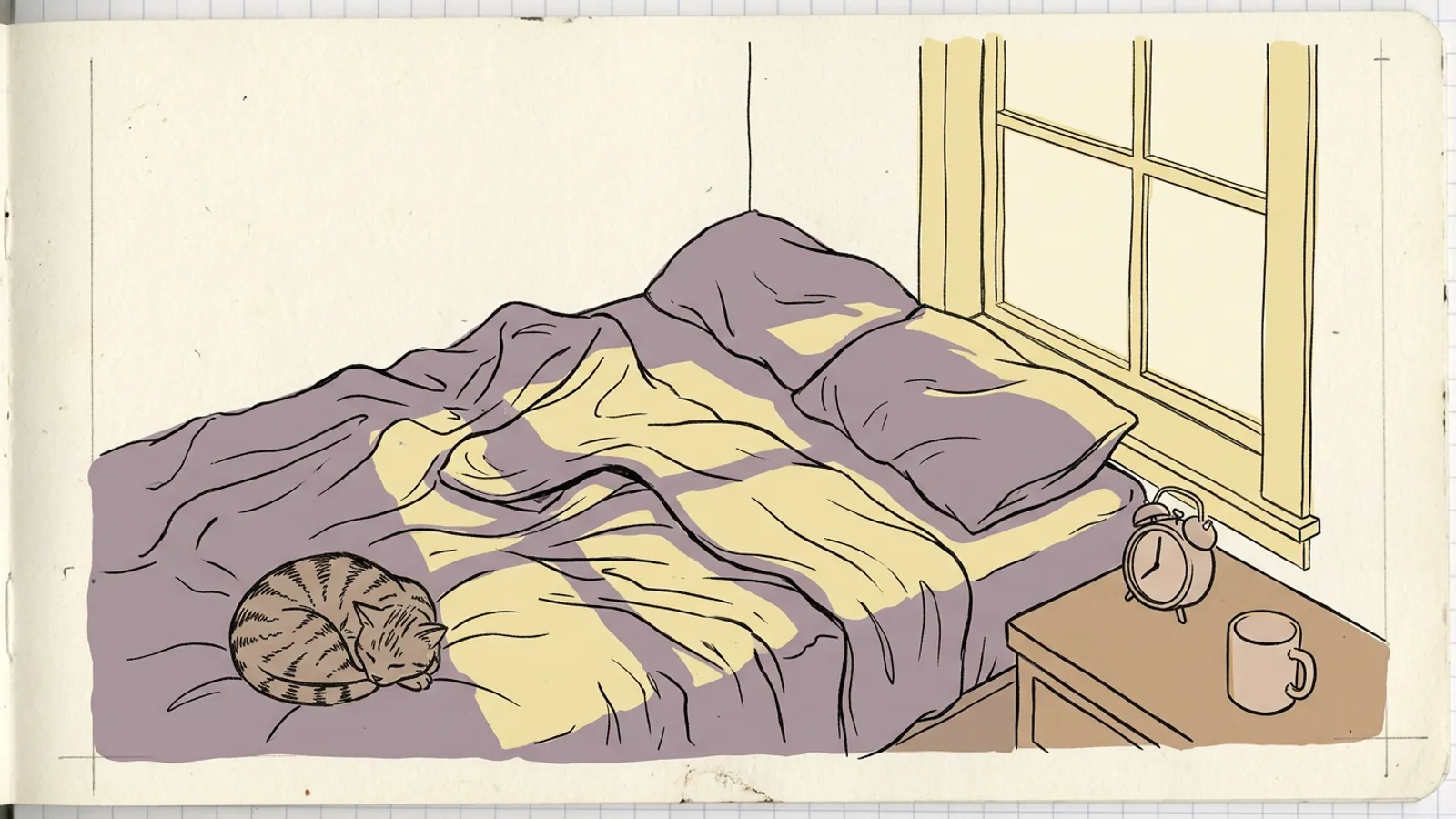
For about a year, "I can't wake up in the morning" was the truest sentence I owned, at least on my days off, however hard I tried. I was working at a call center that closed at 2 a.m., getting home around 3, and setting an alarm for 08:00 because I wanted one normal Saturday like everyone else seemed to have. I would open my eyes at 11:40 a.m. with the phone face down on the floor and no memory of touching it. I put it down to willpower. Then I started writing down when I actually slept, and the spreadsheet told a different story.
If you can't wake up in the morning, most advice jumps straight to habits: put the phone across the room, drink a glass of water, open the curtains. Some of that helps, and I will get to it. I would check two things first, because the habits sit on top of them. The first is how much sleep you are short. The second is where in your night the alarm is going off.
Start with how much sleep you are owed
The National Sleep Foundation brought together a panel of researchers to review the evidence on sleep duration. Their recommendations were published by Hirshkowitz and colleagues in Sleep Health in 2015. For adults from 18 to 64 the panel recommended 7 to 9 hours a night. For people 65 and older it was 7 to 8 hours. Teenagers from 14 to 17 were put at 8 to 10.
Those are ranges for a population, not a prescription for you. Some people do well at the bottom of the range. Very few do well below it, including a lot of the people who say they do.
That last part matters more than it sounds. In a lab study by Van Dongen and colleagues, published in Sleep in 2003, people were kept to six hours in bed a night for two weeks. By the end, their attention and reaction times had slipped to roughly the level of people kept awake for one whole night. When they were asked how they felt, they said only a little sleepy. The deficit kept growing and they stopped noticing it.
So "I feel fine on six hours" is weak evidence. An alarm that feels like being hauled up from the bottom of a lake is much stronger evidence.
Here is what my spreadsheet showed. On work nights I was getting about five and a half hours. Against a target of seven and a half, that is two hours short a night, and across five shifts it came to about ten hours by Saturday. My Saturday body was not lazy. It was collecting.
Paying it back takes longer than one lie-in
The research on recovering from lost sleep is thinner than the research on losing it, so hold this loosely. Kitamura and colleagues, writing in Scientific Reports in 2016, let a small group of healthy young men sleep as long as they liked for more than a week. They estimated that paying back one hour of chronic sleep debt took about four days of extended sleep.
It was a small study of one kind of person, so it is not the final word. It did match what I saw. One long Saturday never undid a week of short nights, and it made Sunday night worse, which made Monday worse.
If you want the number for your own week, the sleep debt calculator adds up what you missed and spreads the payback over the next few nights. That way you are not trying to sleep twelve hours in one go.
Your alarm may be going off at the worst moment
Sleep is not one flat block. It runs in cycles. Each one moves from light sleep down into deep sleep and back up, with a stretch of dreaming sleep near the end. Carskadon and Dement, in Principles and Practice of Sleep Medicine, put a full cycle at roughly 90 minutes, and yours may be 70 or 110. Deep sleep is packed into the first half of the night, and dreaming sleep gets longer toward the morning.
Being pulled out of deep sleep is the worst version of waking. You come up heavy, confused and slow, and you can lose whole minutes to that fog before you understand that the noise is your alarm. That is how people end up turning an alarm off without remembering it. I did it for most of a year.
The counting method I use is simple. Take your wake time and count back in cycles of 90 minutes. Then add about 15 minutes for how long it takes you to fall asleep once the light is off. If I have to be up at 6:30 a.m., five cycles back is 11:00 p.m., so I aim to have the light off around 10:45 p.m. Six cycles back is 9:30 p.m., with the light off near 9:15 p.m.
This is a rule of thumb, not a measurement. Cycles are not identical all night, and a real night has short wakings you will never remember. What the rule gives you is a reason to stop picking a bedtime at random. I wrote up the whole method in what time should I go to bed?, and the sleep calculator does the counting for you.
I should be honest about the limit here. Cycle timing is a tidy idea, and there is not much direct evidence that it prevents grogginess for any one person. It helped me mostly because it moved my bedtime earlier. My guess is that the extra sleep did more than the exact landing.
Weekends move your body clock
Your body keeps its own time, and light is the main thing that sets it. When you sleep until 11:00 a.m. on Saturday and Sunday, that clock drifts later, and nobody tells it that Monday is a work day. Then Monday's alarm goes off at what your body still thinks is the middle of the night.
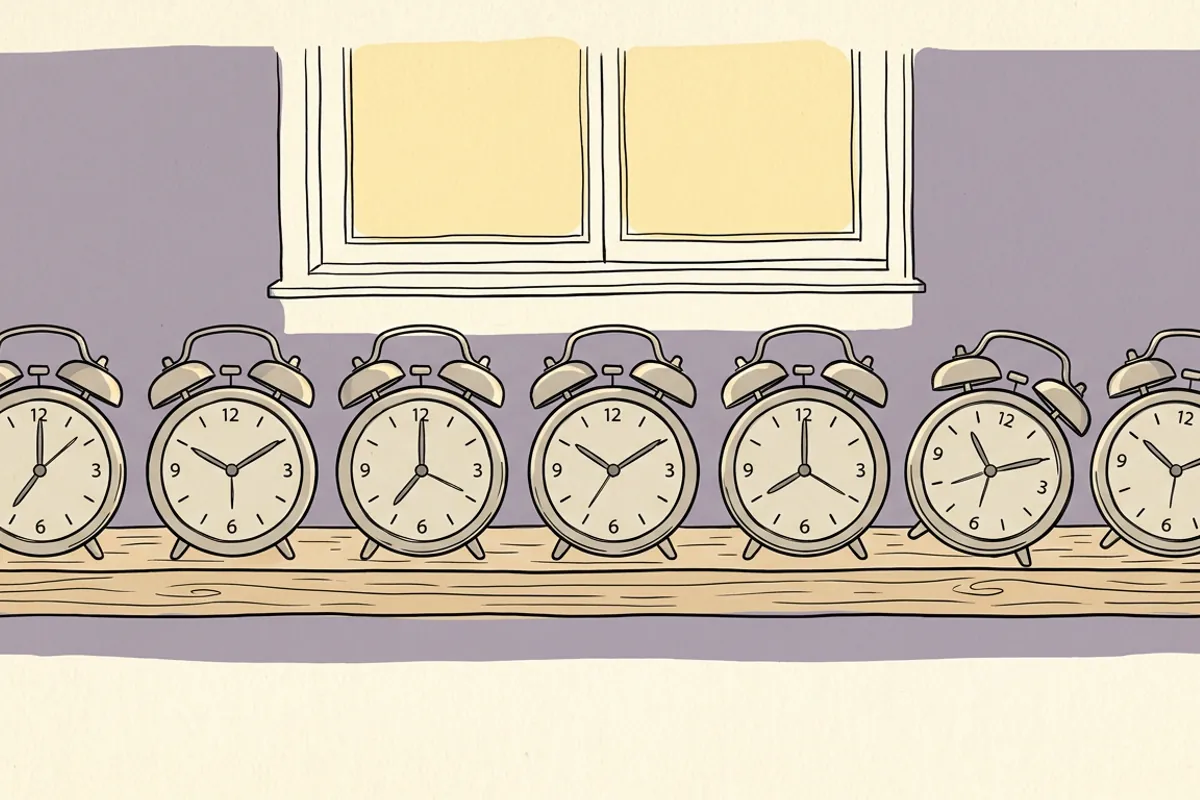
Researchers call this social jetlag. The term comes from Wittmann and colleagues in Chronobiology International in 2006. Roenneberg and colleagues, writing in Current Biology in 2012, found that most people in their large European sample had at least an hour of it. It is so common that it rarely feels like a problem. It just feels like Mondays.
The fix I settled on was boring. I kept my wake time within about an hour of my weekday wake time, every day of the week, and paid off sleep debt with an earlier bedtime instead of a later morning. The first two weekends were miserable. By the third, Monday stopped feeling like a hangover I had done nothing to earn.
Morning light helps the clock settle where you want it. Open the curtains or step outside for a few minutes soon after you get up. It is one of the few bits of morning advice with a clear mechanism behind it.
What the first fifteen minutes feel like, and why
Even with enough sleep and a sensible bedtime, the first minutes after waking are not you at your best. That fog has a name, sleep inertia, which means the slow, clumsy stretch after waking while your brain finishes switching on. Tassi and Muzet reviewed the research in Sleep Medicine Reviews in 2000. Most of it wears off in roughly 15 to 30 minutes, though it can last longer. It is heavier after short sleep and after waking from deep sleep.
Knowing this changed how I read my own mornings. Lying there at 6:31 a.m. thinking "I can't do today" was not a verdict on the day. It was a brain about twenty minutes from being available. Once you know that, you can plan around it. Get upright, get some light, and put off decisions until the fog lifts.
It also explains why the snooze button pulls so hard. Snoozing feels like it softens the fog. Whether it does is honestly unsettled, and the research is thinner than the arguments about it. A study by Sundelin and colleagues in the Journal of Sleep Research in 2023 found that half an hour of snoozing did not hurt habitual snoozers on their tests. I stopped anyway, because snoozing turned one decision into six. I wrote about how I did it in how to stop snoozing.
The habits that helped, and the ones that did not
Once the debt and the timing were sorted, habits did start to help. Here is what I tried, roughly in the order I tried it.
- A louder alarm. It bought me about a week. Then I slept through loud alarms the same way I slept through quiet ones, because the problem was how short and deep my sleep was, not the volume. If that sounds familiar, why do I sleep through my alarm goes further into it.
- The phone across the room. It worked for about a week. Then I learned to walk over, silence it, and walk back to bed without ever properly waking up.
- An alarm that makes me do something. Having to solve a small math problem before the alarm went quiet got my brain past the first few seconds, which is where I used to lose. The online alarm clock has one if you want to try it tomorrow without installing anything.
- Moving my last coffee earlier. This one surprised me. Drake and colleagues, in the Journal of Clinical Sleep Medicine in 2013, gave people caffeine six hours before bed, and it still cut their measured sleep by more than an hour. Caffeine's half-life, the time your body takes to clear half of it, is roughly five hours in healthy adults, and yours may be closer to three or seven. My 4 p.m. coffee was quietly shaving time off my night. The caffeine cut-off calculator counts back from your bedtime.
- Fewer screens in bed. I fell asleep a little sooner. I can't tell you whether that was the light or the fact that I stopped reading arguments at midnight.
- Cold water on my face. Pleasant enough, and it woke me up once I was already standing. It did nothing for getting out of bed in the first place.
The pattern I noticed was that every habit that worked either added sleep or made the first minute of waking harder to skip. The ones that only made the alarm more annoying did not last.
When it is not debt or timing
Sometimes the numbers look fine and mornings are still impossible. You sleep enough, you keep a steady wake time, your coffee is early, and it is still hard to wake up week after week. If that is you, or if you suspect a sleep disorder, a medication or another health condition is behind it, talk to a doctor, and read what I am and am not before taking my spreadsheet for more than it is.
What I would do tonight
Put last week into the sleep debt calculator so you know roughly how much you owe. Pick tomorrow's wake time and decide now that the weekend will not move it by more than an hour.
Then open the sleep calculator, find the bedtime that lands your alarm at the end of a cycle, and plan to have the light off 15 minutes before it. Leave the curtains open a little so the morning gets in.
Give it two weeks before you judge it. My first week felt like nothing was happening. In the second week, I heard the alarm.