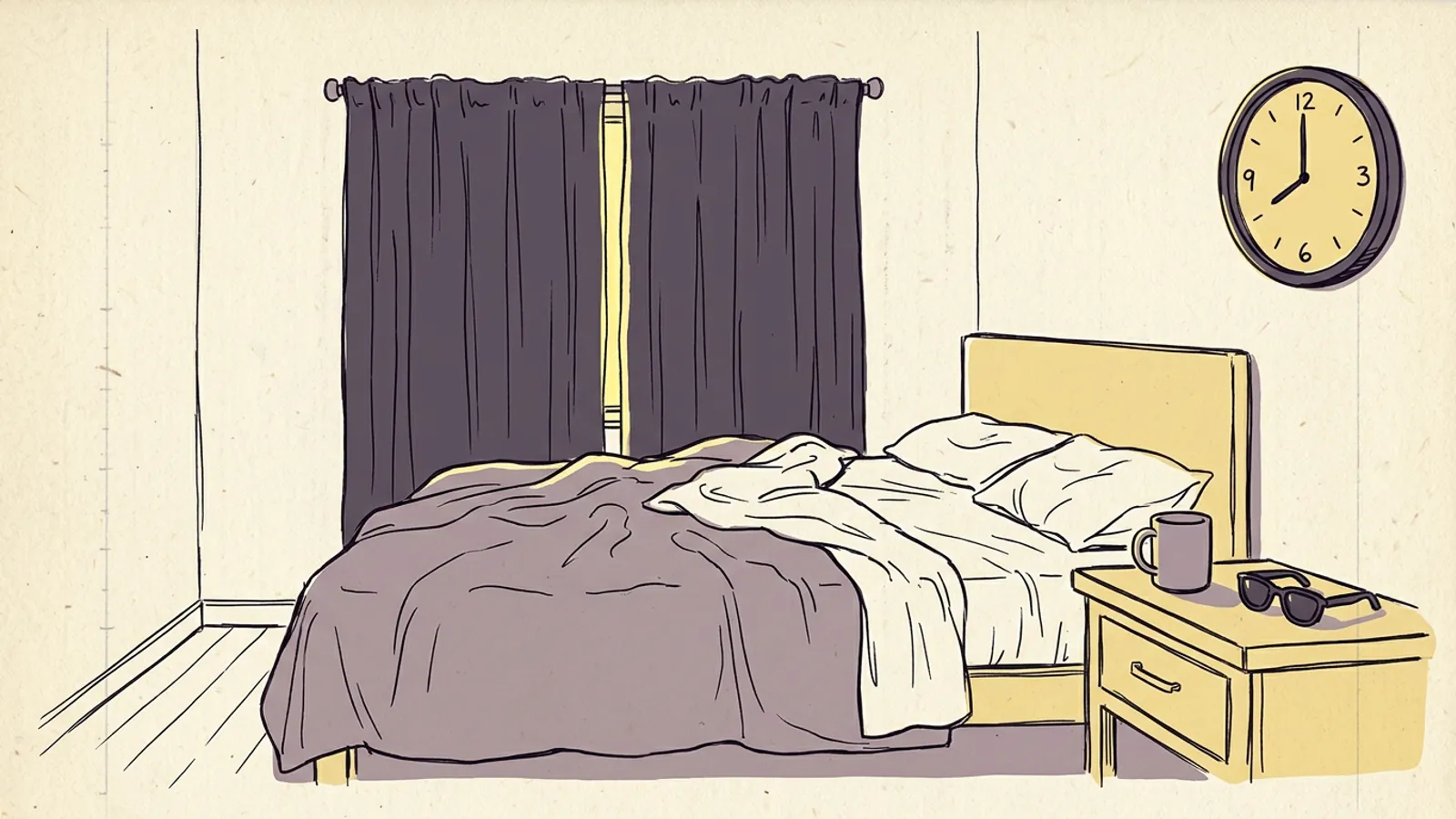
My first night shift sleep schedule was no schedule at all. I finished at the warehouse at 6 a.m., drove home into the sunrise, ate cereal standing up, and went to bed whenever the adrenaline wore off. Some days that was 8 a.m. Some days it was noon, after I had given up on sleep and cleaned the kitchen instead. On my days off I flipped straight back to sleeping at night so I could see people. Then on Monday I would be wired and useless at 3 a.m., sitting on a pallet jack and wondering why my hands felt like someone else's.
I kept that up for most of a year before I started writing things down. The spreadsheet that became this site started there. I logged when I went to bed, when I woke, when I had my last coffee, and how the next shift went. Below is what the numbers showed me and what the research says about shift work sleep.
Why day sleep is harder than night sleep
It is not a willpower problem. Your body runs on an internal clock of roughly 24 hours, the circadian rhythm. That is the clock that makes you sleepy at night and alert in the day, whether or not your job agrees. On a night shift you are asking to be awake near the clock's lowest point, usually somewhere around 3 a.m. to 5 a.m. Then you ask to be asleep in late morning, while the same clock is pushing you awake.
The clock resets mostly from light, and morning light tells it most firmly that the day has started. That makes the drive home at 6:30 a.m., with the sun full in the windshield, about the worst thing a night worker can do for their sleep. Almost every night worker does it anyway, because the car has windows.
Pilcher, Lambert and Huffcutt pooled 36 studies of shift workers in Sleep in 2000. People on permanent night shifts reported shorter sleep than people on permanent days, and nights worked inside a rotation came out shorter still. Those are people's own reports, not lab recordings, but mine said the same. The National Sleep Foundation panel (Hirshkowitz et al., Sleep Health, 2015) recommends 7 to 9 hours for adults. On nights I was averaging a little under six, and the spreadsheet showed every missing hour.
If you want to see what a run of short days adds up to, the sleep debt calculator will do the count. Mine was ugly.
Anchor sleep, the four hours that never move
The idea that changed my weeks most comes from a small paper from 1981. Minors and Waterhouse, in the International Journal of Chronobiology, had people keep one block of about four hours of sleep at the same clock time every day. The rest of their sleep went wherever their routine allowed. They called the fixed block anchor sleep, and they found it kept the body clock steadier than sleeping at scattered times.
It is an old study and a small one, and I would not call it settled. It worked for me, and that is as far as I will take it.
Here is how I used it. My anchor was 9 a.m. to 1 p.m. On work days I slept from 8:30 a.m. to about 3 p.m., which covered the anchor with room on both sides. On days off I went to bed around 4 a.m. and got up around 1 p.m. That is late for a day person, but it kept the anchor where it was.
What I stopped doing was flipping all the way back to a day schedule every weekend. The full flip was what wrecked my Mondays, because my clock never got to settle anywhere.
Picking your own anchor
- Start from when you get home, not when you clock out. Add the commute, a short wind-down, and roughly 15 minutes to fall asleep.
- Choose a four-hour block you can protect on work days and days off alike. For most people on nights it lands somewhere between 8 a.m. and 2 p.m.
- Keep the rest flexible. The extra hours can come before the anchor, after it, or as a nap before your shift.
This is a rule of thumb, not a formula. If errands keep breaking your anchor, it is in the wrong place, so move it.
Light is the lever, in both directions
Once I understood that light sets the clock, I started using it on purpose. I got bright light during the first half of the shift and as little light as I could manage from the end of the shift until I woke up.
The study I lean on here is Smith, Fogg and Eastman in Sleep, 2009. They did not try to make night workers fully nocturnal. They aimed for what they called a compromise: move the body clock partway, far enough that people could sleep in the day and still function on days off. Their volunteers worked simulated night shifts with bright light pulses during the night. They wore dark sunglasses outside on the way home, slept in a dark bedroom on a fixed schedule, and got outdoor light after waking. That group came out ahead of the comparison group on mood, fatigue and performance.
I had no light boxes at a warehouse, so my version was smaller.
- Sit under the brightest lights in the building on breaks before about 3 a.m., and stay out of them after.
- Put on sunglasses the moment I walked out of the building. Dark ones, even when the sky was gray.
- Hang blackout curtains and tape over the gap at the side. That gap let in more light than I expected.
- Open the curtains and step outside for a few minutes when I got up in the afternoon.
The sunglasses did more than anything else on that list. I felt silly wearing them across a parking lot at dawn, and I slept longer.
One warning, and it is about safety, not sleep. Sunglasses help your clock, but they do nothing for how tired you are behind the wheel. More than once I nearly missed my turn on the drive home. If you are nodding off, pull over.
Caffeine timing on a night shift
My mistake was drinking coffee like a day worker. I had it whenever I felt low, which on nights meant 4 a.m. and 5 a.m., the two lowest hours on the clock. Then I got home at 6:30 and wondered why I lay there staring at the ceiling.
Caffeine has a half-life of roughly five hours in most adults, meaning about half of it is still in you five hours after you drink it. That is an average, and yours may be closer to three hours or closer to seven. Drake and colleagues, in the Journal of Clinical Sleep Medicine in 2013, gave people caffeine at bedtime, three hours before, or six hours before. Even six hours ahead, it cut sleep by more than an hour. Those people were sleeping at night. I have never found a reason to think day sleep is less sensitive.
So I moved my coffee to the front of the shift. On a 10 p.m. to 6 a.m. shift my rule was:
- One cup at the start of the shift, and a second around midnight if I needed it.
- Nothing after about 2 a.m., which left six hours or more before an 8:30 a.m. bedtime.
- For the 4 a.m. slump, water, a walk around the loading dock, and a few minutes in the bright break room.
I won't pretend the first week was anything but miserable. By the second week my day sleep had grown by close to an hour, going by the spreadsheet. The caffeine cut-off calculator does the same count back from any bedtime, including a morning one.
Sleeping after night shift, and the nap before it
Getting to sleep quickly after you get home is a skill of its own. What worked for me was keeping the gap short and boring. Sunglasses on, straight home, no bright white screens, a small snack instead of a full dinner, and into bed within about an hour.
I also counted in cycles. A sleep cycle is roughly 90 minutes, according to Carskadon and Dement in Principles and Practice of Sleep Medicine, and yours may be 70 or 110. When my afternoon alarm went off in the middle of a cycle, I woke up feeling like wet sand. When it landed near the end of one, I felt more or less human. The sleep calculator handles an afternoon wake time as easily as a morning one, so give it 15:00 and count back. If the fog after waking is what gets you, I wrote about why you feel groggy after waking up and how long it tends to last.
Then there is the nap before the shift. When my day sleep came up short, an early evening nap before work got me past 3 a.m. without an extra coffee. I kept it either short, around 20 minutes, or long enough to finish a full cycle, around 90. Anything in between woke me at the worst possible moment. The nap calculator will work out the alarm time for you.
Days off, rotating shifts, and when to get help
Days off are where a night shift sleep schedule holds or falls apart. Here is what I learned by getting them wrong.
- Keep the anchor. Sleep later than a day person does, not the way they do.
- If you have to be up for something in the day, sleep through the anchor block, skip the rest, and nap later. One short day costs less than a full flip.
- Before your first night back, stay up a little later and sleep in. Pushing your clock later is easier than pulling it earlier.
Rotating shifts are harder than steady nights, and nothing I tried made them easy. At the hospital switchboard my schedule changed every week. The Pilcher review found that a night worked inside a rotation cost more sleep than a night on steady nights, so it was not just me. On direction, the study I would point to is Czeisler, Moore-Ede and Coleman in Science in 1982. A potash plant in Utah moved its rotating crews from a backward rotation to a forward one, days to evenings to nights, on the reasoning that a body clock moves later more easily than earlier. The workers rated the new schedule and their own health better, fewer of them quit, and output went up. Some crews also went from a weekly change to one every three weeks at the same time, so it is not a clean test of direction on its own, and it measured satisfaction and output more than sleep. If you have any say in your rotation, ask for forward. If you don't, the anchor and the light rules still help. Getting back to normal after you leave nights for good is a different job, and I covered it in how to reset your sleep schedule.
If you are still sleeping badly for weeks with all of this in place, or you are thinking about melatonin or sleeping pills, talk to a doctor, and you can read what I am and am not on the about page.
Tonight, or this morning, depending on your shift, pick one change. Write down your four-hour anchor, set your alarm for the end of a cycle, and leave the sunglasses by the door so you don't have to think about them at 6 a.m.