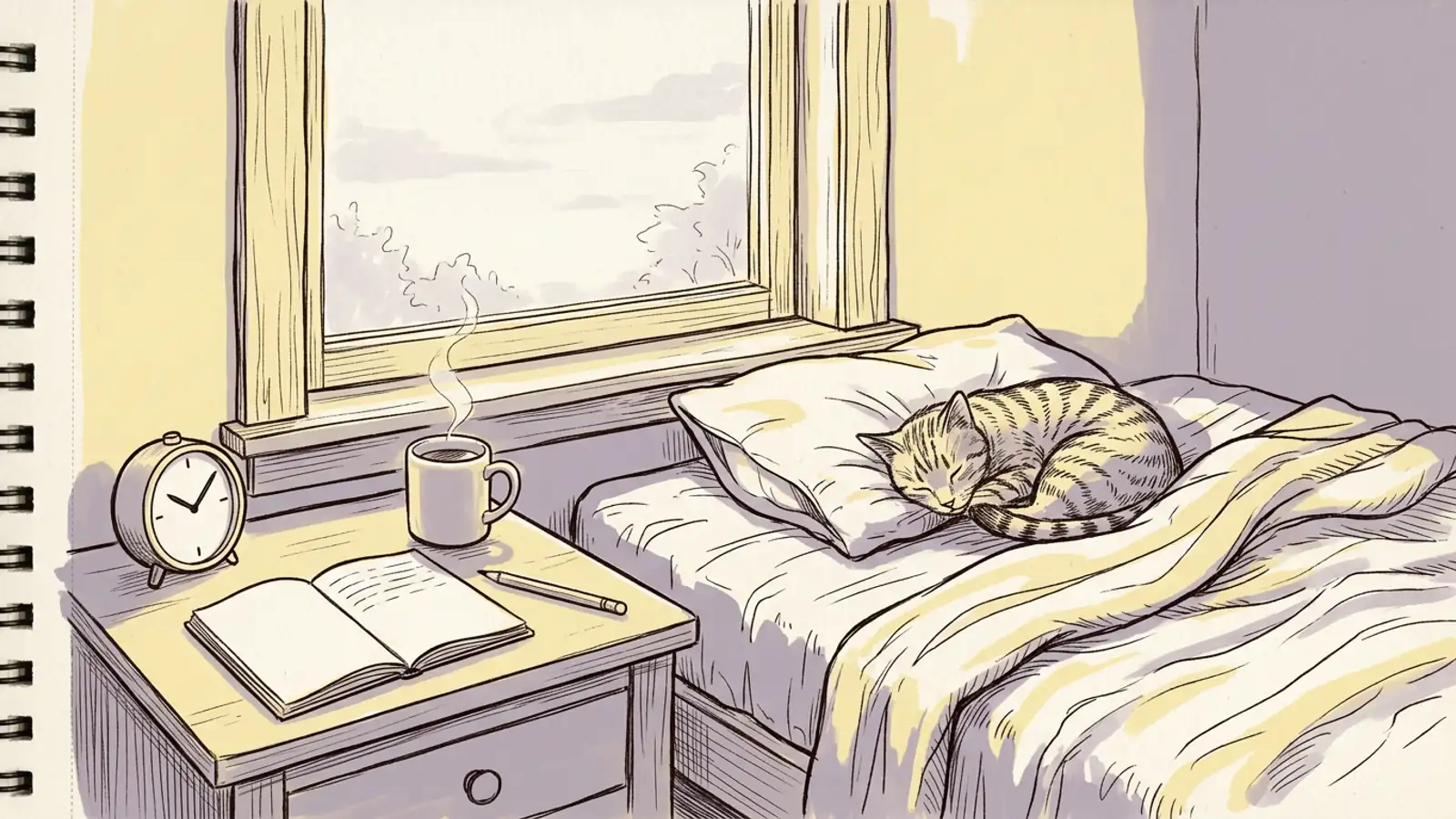
The night I typed "how to reset sleep schedule" into my phone, it was 2:40 a.m. I had a day job starting in nine days and four years of going to bed around 3 behind me. The search gave me two kinds of advice. One camp said to move my bedtime 15 minutes earlier each night. The other said to stay up all night once and fall into a new schedule the next evening. I tried both, in the wrong order, and I can tell you now which one does what.
What actually slipped when your schedule slipped
A sleep schedule is two things pretending to be one. There is the time you get into bed, which you choose. And there is your body clock, the roughly 24-hour internal rhythm that decides when you feel sharp and when you feel heavy, which you do not get to choose directly.
The classic way to describe this is Alexander Borbély's two-process model (Human Neurobiology, 1982). The first process is sleep pressure, the need for sleep that builds the longer you are awake and drains while you sleep. The second is the circadian rhythm, the clock itself, which runs on its own timetable and takes most of its cues from light. You fall asleep easily when the pressure is high at the same moment the clock says night.
After a stretch of late nights, both have moved. Late light has pushed your clock later. Late wake-ups mean your pressure starts building later in the day. So at 11 p.m., the bedtime you want, your clock still thinks it is early evening and your pressure has had maybe fourteen hours to build instead of sixteen. You lie there doing sums about the morning. That is not a character flaw. It is two timers set to the wrong hour.
This one idea decides which method you should use. The 15-minute method moves the clock. The one-night reset piles on pressure. Different tools, different jobs.
The 15-minutes-a-night method
Pick the time you want to be asleep. Measure the gap between that and when you actually fall asleep now. Then close the gap by 15 minutes a night, and move your alarm by the same 15 minutes every morning.
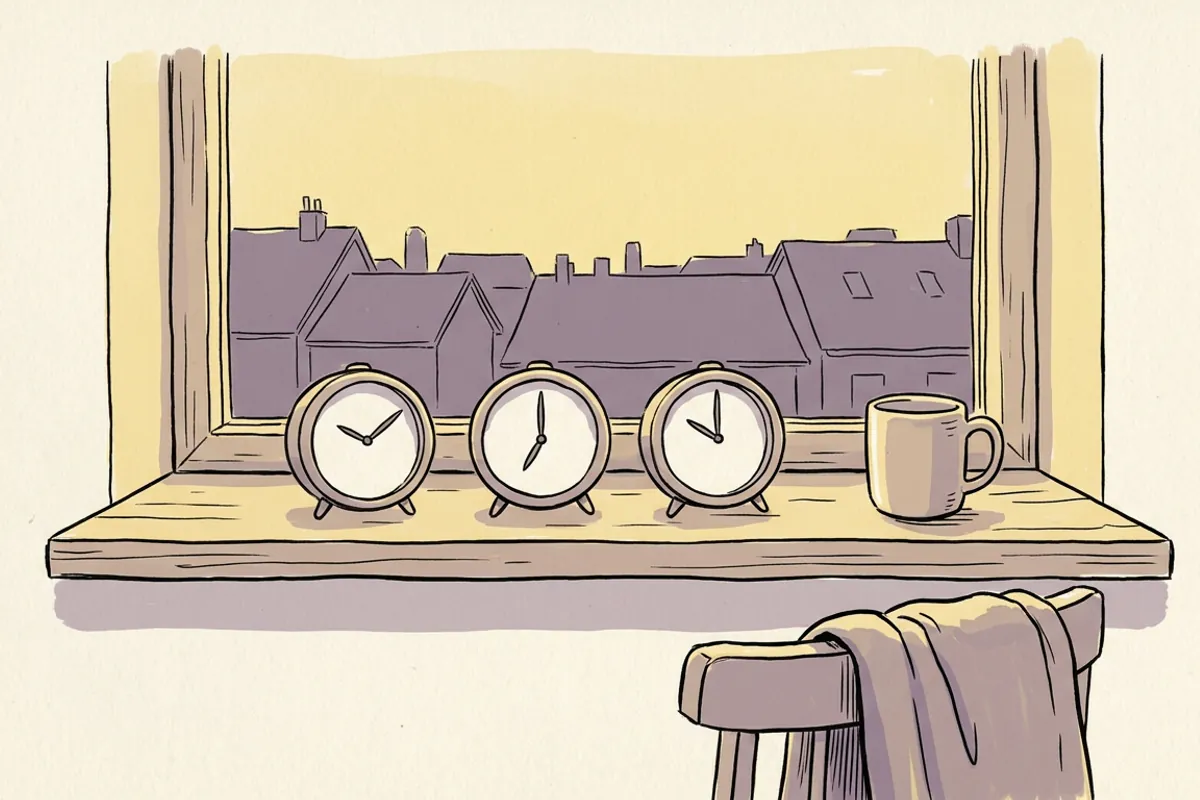
That second half is the one people skip. If you go to bed 15 minutes earlier but still sleep until 9, your clock has no reason to move, and you have just added 15 minutes of lying in the dark. The wake-up time is the anchor. Bedtime follows it.
The arithmetic fits on the back of a receipt. Say you fall asleep around 1:00 a.m., get up at 8:30, and need to be up at 6:30 for good.
- Night one, lights out at 12:45 a.m. and the alarm at 08:15.
- Night two, lights out at 12:30 a.m. and the alarm at 08:00.
- Night eight, lights out at 11:00 p.m. and the alarm at 06:30.
A two-hour gap is eight nights. A three-hour gap is twelve.
Why 15, and whether you can go faster
Fifteen minutes is a rule of thumb, not a number from a trial. I have not found a study that shows 15 beats 20. It is simply small enough that the clock keeps up without help and the alarm never feels like an ambush.
The clock can move faster. A common rule of thumb from jet lag research is that it shifts by roughly an hour a day, and moving earlier is harder than moving later. Charmane Eastman and Helen Burgess, who have spent years working out how to shift the human clock earlier, describe pre-flight plans that advance it about an hour a day, and those plans lean heavily on bright light first thing in the morning (Sleep Medicine Clinics, 2009). Without that kind of light, a slower pace is the safer bet. Thirty minutes a night works for plenty of people. Fifteen is the version you can do while also having a life.
The one-night reset, and what it cannot do
The one-night reset goes like this. You stay up all night, or get up absurdly early, push through the whole next day, and go to bed at your target bedtime with so much sleep pressure that you drop off at once.
It does work for that one night. You will fall asleep at 10:30. The trouble is night two. Pressure does not move the clock. If you sleep in the next morning, or spend it in a dim room, your clock is still roughly where it was, and by the second evening it has its opinion back.
That was my mistake. With nine days to go, my spreadsheet said 15 minutes a night would take sixteen nights to cover four hours, so I skipped it and stayed up all night instead. I made it to about 4 p.m. the next day, sat down on the couch "for a minute" and woke up at 9 p.m. feeling wonderful. I was awake until 4 a.m. One nap had drained every hour of pressure I had paid for, and I had lost a day on top of it.
What I did next was the dull version. I took the four-hour gap, split it into 30-minute steps, and moved the alarm with it for eight days. On nights five and six I lay awake for what felt like 40 minutes. By the first morning of the new job I was falling asleep around 11:30, not 11, and getting up on time. Not perfect. It held.
The cost of staying up
An all-nighter is not free. After 17 to 19 hours awake, the people in Ann Williamson and Anne-Marie Feyer's study performed some tasks as poorly as they did with a blood alcohol level of 0.05 percent (Occupational and Environmental Medicine, 2000). An all-nighter puts you well past 19 hours by mid-morning. Do not drive, and do not pick this method for a day that needs you sharp.
The gentler one-night version
If you want the pressure without the wreckage, take a short night instead. Go to bed at your usual late time, set the alarm for your target wake time, get outside into daylight soon after you get up, and do not nap. You will be tired by evening, which is the point, and you will have lost two hours, not a whole night. The next morning, same alarm.
I would take this over an all-nighter every time. If you want to see what that short night adds to your week, the sleep debt calculator will count it for you.
Which one fits your drift
The honest answer depends on how far you have drifted and for how long.
- If a weekend or a holiday week pushed you an hour or two later, the short night plus a fixed alarm is usually enough. The clock has not wandered far.
- If you are three hours or more out, or it has been months, or you are coming off shift work, go with 15 or 30 minutes a night. One night of pressure will not drag a clock that far, and you will spend the second week fighting it anyway.
- If you have an early start tomorrow and no time for either, the one-night reset will get you through one morning. Treat it as a patch and start stepping the next day.
The two also combine well. A short night on day one, then 15-minute steps from wherever you land, is roughly what I would do today if I had to move three hours in a hurry.
If you have given either method a fair two weeks and still lie awake for hours most nights, talk to a doctor, because insomnia is outside what I can help with, as my about page explains.
Morning light does more work than bedtime
If you only change one thing, change your mornings. Light is the main cue your body clock uses, and when it arrives matters as much as how bright it is.
Sat Bir Khalsa and colleagues mapped this in a study of how light at different hours shifts the clock (Journal of Physiology, 2003). Light in the hours after your usual wake-up pushes the clock earlier. Light in the late evening and the first half of the night pushes it later. Same light, opposite direction, depending on the hour.
The version I remember best is Kenneth Wright's camping study (Current Biology, 2013). People spent a week outdoors with sunlight and campfires and no electric light, and their internal clocks shifted roughly two hours earlier, lining up with sunrise and sunset. Nobody told them to go to bed early. The light did it.
So during a reset I get outside within about half an hour of the alarm, even on a gray morning, because daylight on a cloudy day is still far brighter than a kitchen. In the evening I switch off the big overhead light and keep one lamp on for the last hour. None of this is dramatic. It is the part that makes the new bedtime stick.
Weekends, where most resets come undone
You can do eight careful nights and lose most of it in one Saturday. Sleep in until 11 and you have given your clock three hours of late morning darkness and a late start on sleep pressure. By Sunday night, 11 p.m. feels like 9 again.
Marc Wittmann, Till Roenneberg and colleagues gave this a name, social jetlag, meaning the gap between when your body wants to sleep on free days and when your work days make you sleep (Chronobiology International, 2006). Every weekend lie-in is a small flight west, and every Monday you fly back.
My rule of thumb is to keep the weekend alarm within about an hour of the weekday one while the reset is settling. That is my number, not a study's. If you find you badly need the lie-in, you are probably short on sleep, and the better fix is an earlier bedtime on Friday. I wrote more about that in can't wake up in the morning? Check your sleep debt first.
Your first step tonight
Decide the wake-up time you want to keep, because the whole reset hangs on it. Put it into the sleep calculator and it will give you bedtimes that land at the end of a sleep cycle. A cycle is roughly 90 minutes by the figures in Carskadon and Dement's chapter in Principles and Practice of Sleep Medicine, and yours may be 70 or 110, so treat the times as a starting point. Most adults need 7 to 9 hours, according to the National Sleep Foundation panel (Hirshkowitz et al., Sleep Health, 2015).
Then write down two times. Tonight's lights-out, 15 minutes earlier than usual. Tomorrow's alarm, 15 minutes earlier than today's. Set that alarm before you get into bed, put the phone out of reach, and open the curtains as soon as it goes off. If you are still unsure where the target bedtime should sit, what time should I go to bed? walks through the counting.