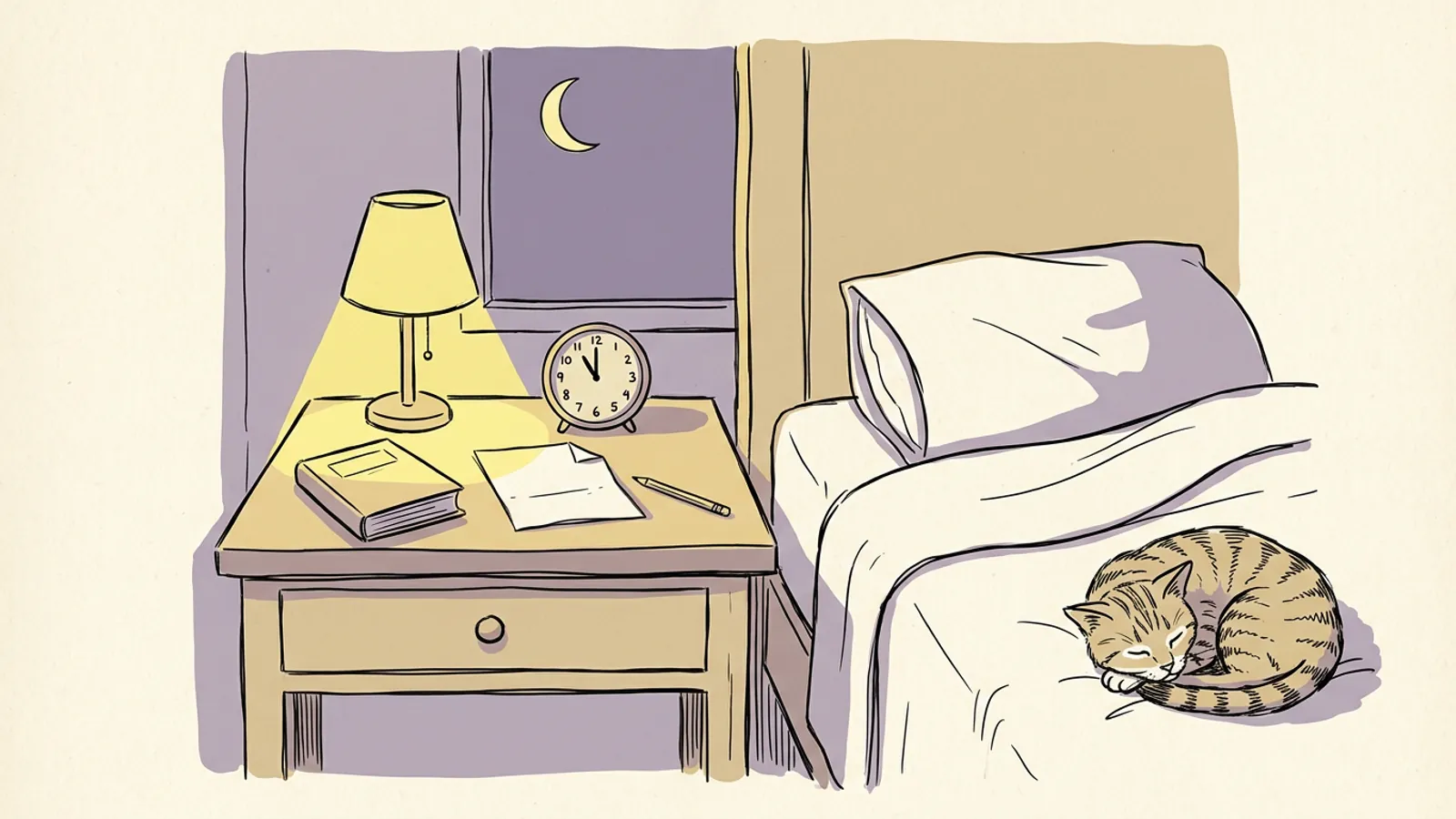
A bedtime routine never worked for me as a list of nice habits: chamomile, a candle, a book I never finished. What finally stuck was a routine with a start time, and the start time came from arithmetic. I take the alarm, count back in sleep cycles to a bedtime, then count back another 30 minutes. That half hour is the whole routine, and everything in it has to earn its minutes.
Why my bedtime routine starts from the alarm
At the call center, the phones went quiet at 2 a.m. and I was home by 2:40. I told myself I was winding down. Really I sat on the kitchen floor scrolling until the sky went gray, then panicked, then lay in bed doing sums about how little sleep was left. My night routine had no end, so it had no beginning either. It just leaked into the time I was supposed to be asleep.
The fix was boring. I wrote the bedtime into my spreadsheet first and the routine second, as a block that had to finish at that bedtime. Once the routine had an end time, it had a start time. Once it had a start time, I noticed when I was late for it, the way you notice being late for a bus.
Most advice about a bedtime routine for adults starts at the other end, with the calming things: a warm drink, some stretching, a journal. I have nothing against any of them. But a routine that begins whenever you feel like it tends to begin at 11:40 p.m. for a 6:30 a.m. alarm, and no amount of lavender fixes that.
Get the bedtime from the alarm first
Start with the time you have to be up. Mine is 6:30 a.m. on work days.
Sleep comes in cycles of light sleep, deep sleep and REM, the dreaming stage, and you go through several of them a night. The textbook figure for one cycle is roughly 90 minutes, from Carskadon and Dement's chapter in Principles and Practice of Sleep Medicine. That is an average. Yours may be 70 or 110, and cycles change length across the night. I wrote more on that in the 90 minute sleep cycle is an average.
The point of counting in cycles is to wake at the end of one instead of in the middle of deep sleep. So from 6:30 a.m.:
- Five cycles is seven and a half hours, so sleep starts at 11:00 p.m.
- Add about 15 minutes to fall asleep, which is a rule of thumb and not a law, and the light goes off at 10:45 p.m.
- Four cycles, six hours, would mean lights out at 12:15 a.m. That is the emergency option, not the plan.
Five cycles lands inside the 7 to 9 hours a night that the National Sleep Foundation panel recommends for adults aged 26 to 64 (Hirshkowitz et al., Sleep Health, 2015). Six cycles would be nine hours, which I have managed about twice in my adult life.
The sleep calculator does this sum for any wake time and gives you four bedtimes to pick from. I pick the one with five cycles and count back 30 minutes more. For me that is 10:15 p.m., and it is the only time in my evening I treat as fixed.
The 30 minute wind down routine, counted backwards
I think of the half hour as three blocks of ten minutes. I build them from the end, because the end is the part that cannot move.
The last ten minutes are in bed
From 10:35 to 10:45 p.m. I am in bed with the lights low and a paper book. It should not be a good book, because a good book is how 10:45 turns into 12:10. I keep something I have read before on the nightstand, so no cliffhanger pulls me along.
Why paper? In a study by Chang and colleagues (PNAS, 2015), people who read on a light-emitting tablet before bed took longer to fall asleep and felt less sleepy in the evening. Their melatonin, the hormone that tells your body it is night, also came later than when the same people read a printed book. The fair caveat is that they read for about four hours a night, five nights running, in a lab. Ten minutes on a phone is a much smaller dose. For me the phone's bigger problem was never the light. It never runs out of things to show me.
The middle ten minutes are the list
At 10:25 p.m. I sit at the kitchen table and write tomorrow's to-do list. It sounds like work. If I could keep only one part of the routine, I would keep this one.
Scullin and colleagues (Journal of Experimental Psychology: General, 2018) had 57 young adults spend five minutes before bed writing one of two lists. One group listed what they had to do in the coming days, and the other listed what they had already done. The to-do group fell asleep roughly nine minutes faster, and the more specific their lists, the faster they fell asleep. It is one small lab study of young adults, so I hold the number loosely. It does match what happened to me. The worrying about tomorrow I used to do in bed now happens on paper.
While I am up, the lights go down. The overhead lights go off and one lamp stays on. I can't honestly give you a brightness figure for a normal home, so this is a rule of thumb: if the room looks like an office, it is too bright.
The first ten minutes are chores
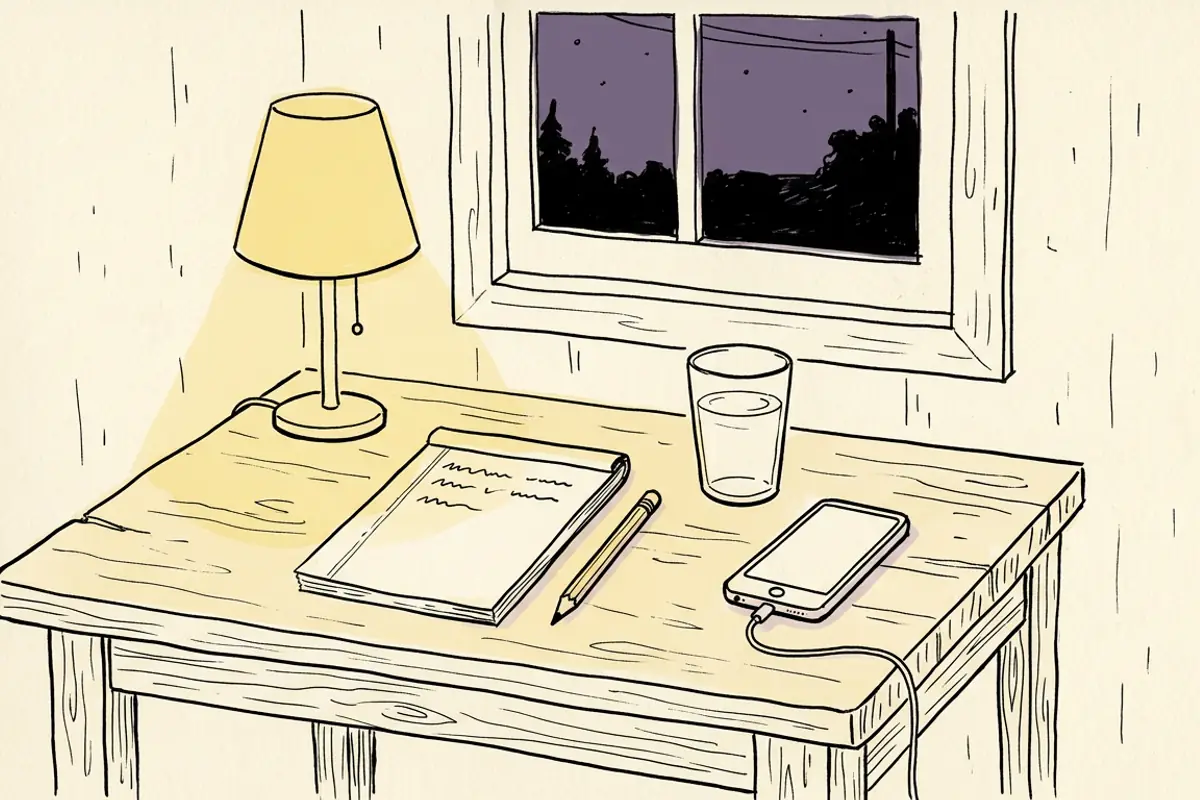
The block from 10:15 p.m. is dull on purpose. I brush my teeth, wash my face, fill a water glass, put tomorrow's clothes on the chair, plug the phone in to charge in the kitchen and lock the door.
Each of those is a reason to get back out of bed later. If I do them first, there is nothing left to get up for once I lie down. On nights I skip this block, I am up at 10:52 p.m. checking the lock, and the fifteen minutes to fall asleep start again from zero.
If your phone is also your alarm, charging it in another room is a problem. A cheap plain clock by the bed solves it, and when I am away from home I use the online alarm clock in a browser tab.
What sits outside the 30 minutes
Two things that matter for sleep do not fit in a half hour. The calculator's bedtime is the anchor for both.
The first is caffeine. In a study by Drake and colleagues (Journal of Clinical Sleep Medicine, 2013), 400 mg of caffeine taken six hours before bed still cut total sleep by more than an hour. That is a lot of caffeine, around four cups of brewed coffee depending on the cup. What surprised me was the six hours. With lights out at 10:45 p.m., six hours back is 4:45 p.m., and my old 4 p.m. coffee fell inside that window. The caffeine cut-off calculator counts back from your bedtime using caffeine's half-life, and I wrote up what I changed in how long before bed to stop drinking coffee.
The second is a warm bath or shower, and here the timing is the whole trick. Haghayegh and colleagues pooled the earlier studies (Sleep Medicine Reviews, 2019). They found that bathing in water around 104 to 108 degrees Fahrenheit one to two hours before bed helped people fall asleep faster, by roughly ten minutes on average. The explanation is that warm skin lets heat escape, and a falling body temperature is part of how you drift off. A shower five minutes before bed doesn't leave time for that. For a 10:45 p.m. lights out, the window is 8:45 to 9:45 p.m.
I don't take a bath most nights. When I remember, I shower around 9:30 p.m., and I can't honestly tell you whether it helps me. My water heater rarely reaches 104 degrees anyway.
What I tried that did not earn its minutes
A routine is only 30 minutes long, so everything in it has to be worth its place. Here is what I tried and dropped:
- Meditation apps. I kept opening the app and then the email icon next to it. That was my failure more than the app's, but the result was the same.
- Stretching in the bedroom. It was nice, and it also woke me up, because my stretching kept turning into tidying.
- A strict rule of no screens after 9 p.m. I broke it at 9:20 p.m. on day two. A rule I can't keep is worse than a small one I can, because breaking it made me give up on the rest of the evening too.
- Chamomile tea. It was pleasant, and it got me up for the bathroom at 2 a.m. I moved it to right after dinner.
The research is thinner than routine advice makes it sound. Most studies of whole bedtime routines are about young children. Mindell and Williamson reviewed them in Sleep Medicine Reviews in 2018, and the benefits there look solid. For adults, the pieces have mostly been tested one at a time, like the to-do list or the bath. A review of sleep hygiene advice by Irish and colleagues (Sleep Medicine Reviews, 2015) found mixed evidence for many individual tips. So I wouldn't trust anyone who calls one particular routine proven. What I can say is that doing the same short sequence at the same time gave my evenings an end point, and that was what I had been missing.
When the routine is not the problem
A routine helps an ordinary tired brain get to sleep on time. If you follow one for a few weeks and still lie awake most nights, or wake up exhausted after a full night, that is a question for a doctor and not a spreadsheet, and my about page says what I am and am not.
A more common problem is a routine built around a bedtime that was never realistic. If you have been short on sleep all week, a perfect half hour at 10:15 p.m. won't make Friday morning easy. The sleep debt calculator shows roughly how far behind you are. What sleep debt is covers why one long Saturday of sleeping in never paid mine back.
Some nights you will start late. If I am a few minutes late, I rush the chores and keep the bedtime. If I am more than half an hour late, I move to the next bedtime on the calculator, four cycles instead of five, and do the whole routine from there. That makes for a shorter night. For me, though, waking at the end of a cycle has usually beaten waking in the middle of one.
Tonight
Open the sleep calculator, enter tomorrow's alarm and pick the bedtime that gives you five cycles. Subtract 30 minutes and write that time somewhere you will see it at dinner. When it comes around tonight, do the chores, write the list, switch off the big light and get into bed with a book whose ending you already know.