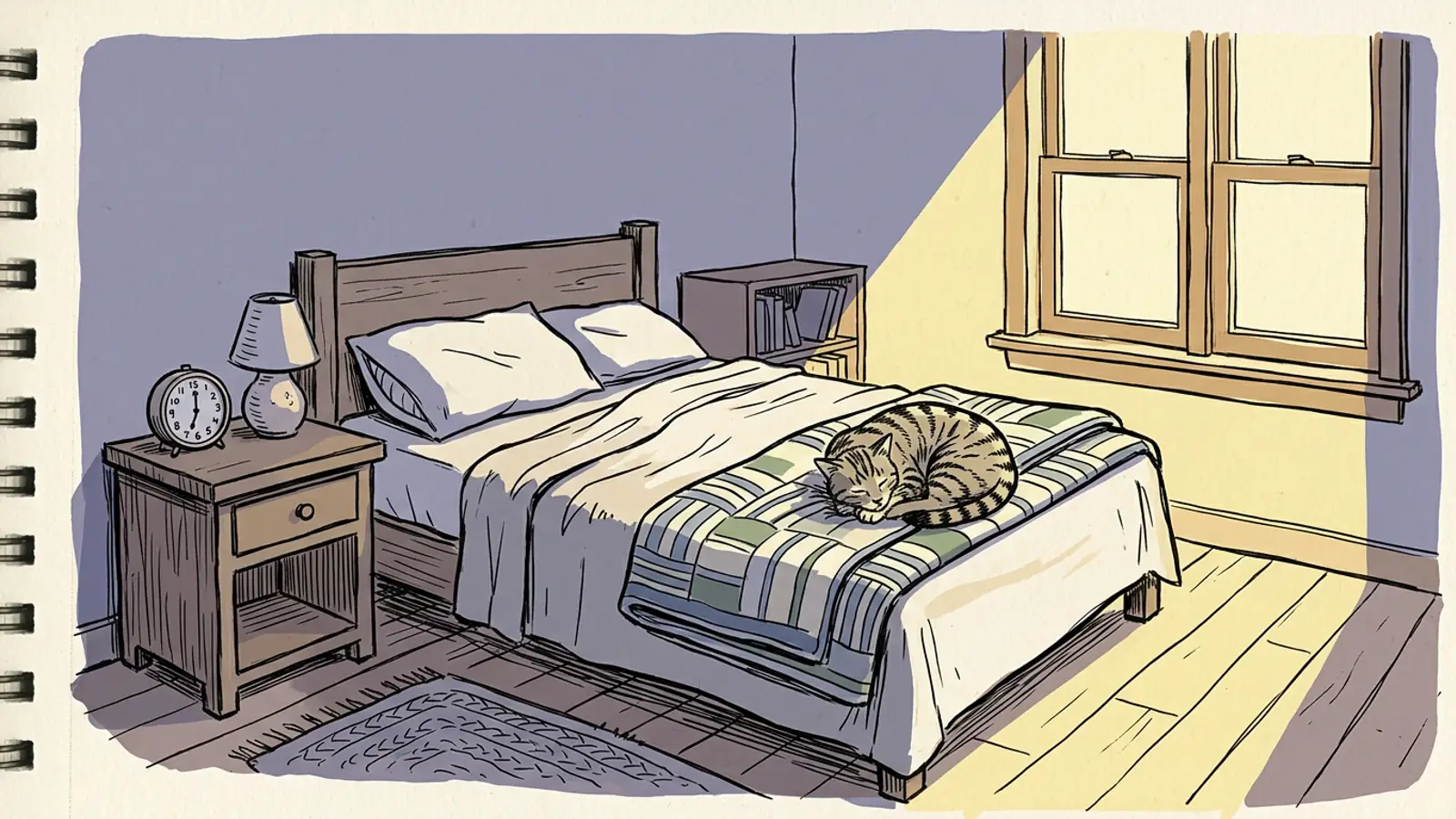
When I moved off late shifts and onto a day job, I had to work out how to wake up early. I went about it the way most advice tells you to. I set my alarm for 6:15 a.m. and decided I was a morning person now. My body had spent years going to bed around 3 a.m., and it did not get the memo. I kept falling asleep at 1:30, dragged myself up on under five hours and made it to Thursday. On Saturday I slept until 12:40 in the afternoon. By Monday I was back where I started, only more tired.
That week taught me the idea this whole article rests on. You mostly decide whether you wake up early the night before, at the other end of your sleep. If you move the alarm and leave your bedtime where it is, you are not building a habit. You are cutting sleep, and your body collects that debt with interest.
Why willpower loses at 6 a.m.
The trouble with forcing an early alarm is that the part of you making the decision is barely awake. For a while after you open your eyes you are in what researchers call sleep inertia. That is the plain name for the slow, clumsy, groggy feeling right after waking. Tassi and Muzet reviewed the research in Sleep Medicine Reviews in 2000. The grogginess usually fades within about 30 minutes, though it can last longer when you are short on sleep or woken from deep sleep.
So the version of you who set a brave new alarm at 10 p.m. is not the one who has to obey it. The one who has to obey it is foggy and warm, and very persuasive about five more minutes. I lost that argument most mornings for years. If snoozing is your particular trap, I wrote up what finally stopped me snoozing. Even the best tricks there work better once the sleep underneath is fixed.
The second problem is quieter. Your body clock, the internal timer that decides when you feel sleepy and when you feel alert, does not care what your alarm says. It runs mostly on light, and on habit. If it thinks bedtime is 1 a.m., you will lie there wide awake at 11 no matter how early you plan to get up. That is why the early night you promise yourself rarely happens on the first try.
The arithmetic of an earlier morning
This is the math I started with, and it still sits at the top of my spreadsheet.
Start with the time you want to wake up, then count back the sleep you need. The National Sleep Foundation panel (Hirshkowitz et al., Sleep Health, 2015) recommends 7 to 9 hours for adults aged 18 to 64, and 7 to 8 hours from 65 on. Those ranges describe groups, not a prescription for you, but they are a reasonable place to start.
Next, sleep comes in cycles. Carskadon and Dement, in Principles and Practice of Sleep Medicine, put one cycle at roughly 90 minutes, and yours may be 70 or 110. Waking at the end of a cycle tends to feel easier than being pulled out of the middle of one. That part is a rule of thumb, because nobody's cycles are perfectly even through the night. Still, it matched my own mornings better than I expected.
Then add the time it takes you to fall asleep once the light is off. For a lot of people that is about 15 minutes. Mine was closer to 25 during the switch, because my body clock was still arguing.
Here is how that adds up for a 6:30 a.m. wake time:
- Five cycles of 90 minutes is seven and a half hours, so you need to be asleep by 11:00 p.m.
- Add 15 minutes to fall asleep, and lights out is about 10:45 p.m.
- Six cycles would mean lights out around 9:15 p.m. That is more sleep than most adults will actually get.
The sleep calculator does exactly this sum and gives you four bedtimes to choose from. If you want the longer version of the reasoning, what time should I go to bed walks through it.
The number that matters for the plan is the gap. Say you fall asleep at 12:30 a.m. now and your target is 11:00 p.m. You need to move an hour and a half. Nobody moves an hour and a half in one night and keeps it.
The two-week plan
This is roughly what I did the second time, after the failed week, and I would do it again. You move bedtime and wake time together in small steps, so your body clock gets dragged along rather than ambushed.
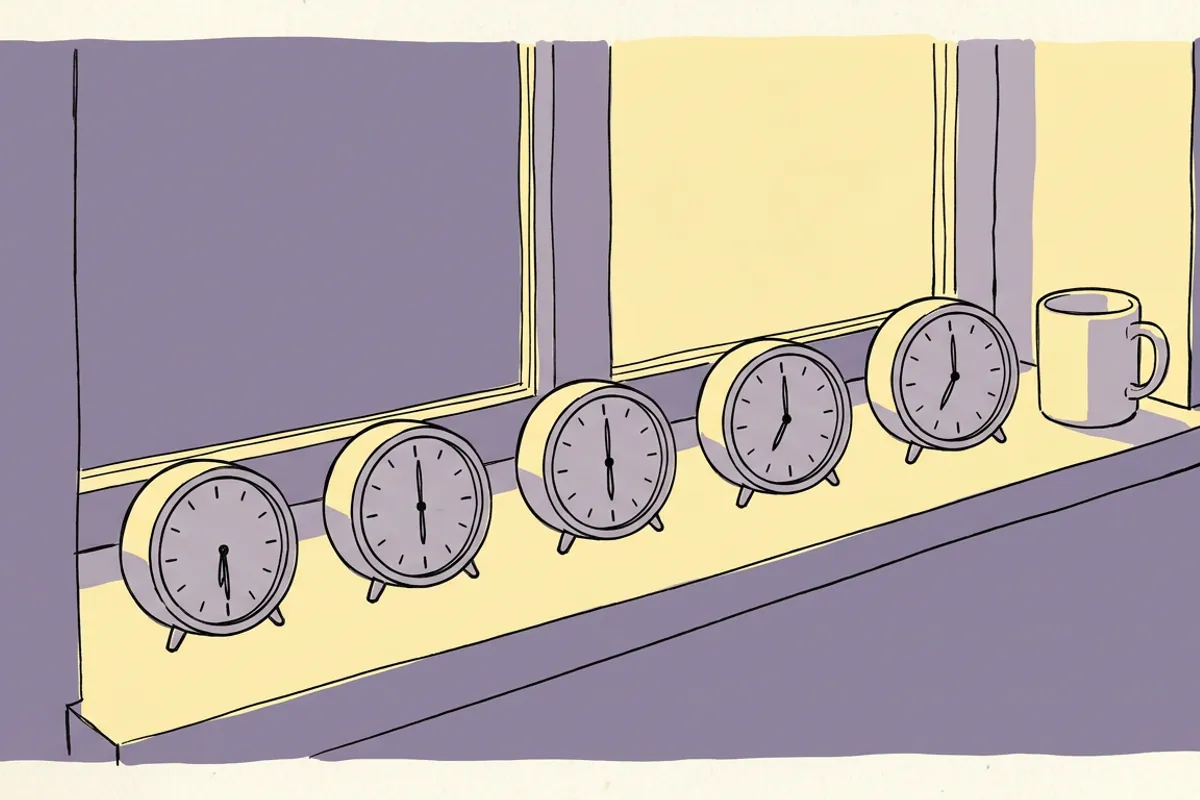
How fast can you shift? Most research on moving a body clock earlier comes from lab and jet lag studies, and people vary a lot. Moving earlier is generally harder than moving later. So I treat 15 to 30 minutes every two or three days as a rule of thumb, not a finding. It was slow enough that I rarely noticed it happening.
Before you start
Write down when you actually fell asleep and woke up each night last week. I don't mean when you went to bed. I mean when you think you fell asleep. Then put those nights into the sleep debt calculator. If you are already several hours short, the first few days of the plan should not cut any sleep. It helps to know that before an early alarm makes things worse. Can't wake up in the morning covers exactly that situation.
Days 1 to 3
Move both your wake time and your lights out 15 minutes earlier than your current habit. Only 15. Set the alarm on the online alarm clock or wherever you usually set it, and get up at the first ring. Go outside or sit by a bright window within the first half hour.
Days 4 to 7
Move both another 15 to 30 minutes earlier. If you lie awake for more than half an hour at the new lights out, stay at this step for an extra night or two instead of pushing on. That happened to me on day five, and two more nights at the same step fixed it.
Days 8 to 11
Move another 15 to 30 minutes. By now you should be within about half an hour of your target. On most mornings the alarm should land near the end of a cycle, because you picked the bedtime from the calculator.
Days 12 to 14
Settle on your final times and keep them, weekend included. This part decides whether it lasts. There is nothing magic about two weeks. It is simply long enough to cover an hour or an hour and a half at a pace most people can live with. If your gap is bigger, the plan takes longer, and that is fine.
Light, coffee and the weekend
A few things can quietly undo the plan. I tripped on each of them.
Morning light does the heavy lifting
Light is the main signal your body clock uses to set itself. The clearest demonstration I know is a camping study by Wright and colleagues in Current Biology, 2013. People spent a week outdoors with natural light only, no electric light. Their internal clocks moved about two hours earlier and lined up with sunrise and sunset. You do not need a tent. You need daylight soon after the alarm and less bright screen light late at night. On gray winter mornings I stood at the kitchen window with my coffee. That is not the same as being outdoors, but it beat my dim hallway.
Coffee stays in you longer than it feels
Caffeine has a half-life of roughly five hours. That means about half of it is still in your blood five hours after you drink it, and for some people it lingers much longer. Drake and colleagues, in the Journal of Clinical Sleep Medicine in 2013, gave people a strong dose six hours before bed. Their sleep still dropped by more than an hour. When your bedtime moves earlier, your last coffee has to move earlier too. The caffeine cut-off calculator counts back from your new bedtime to find it. My 3 p.m. coffee became a 1 p.m. coffee, and I grumbled about it for a week.
The weekend sleep-in
Sleeping in on Saturday feels like a reward. Your body clock does not know it is a treat. It sees the light arrive late and starts setting itself to match. Wittmann, Dinich, Merrow and Roenneberg named this social jetlag in Chronobiology International in 2006. It means the gap between when you sleep on work days and when you sleep on free days. My 12:40 p.m. Saturday was that gap at its widest, and Monday was when I paid for it. I now keep my weekend wake time within about an hour of my weekday one, which is my own rule, not a study's. If you are short on sleep, an earlier bedtime pays it back more gently than a long lie-in.
When the plan stalls
Some weeks will not go smoothly. That does not make you a hopeless night owl.
People really do differ in when their body clocks run, and a late one is not a character flaw. Some of us are built later. A late type can still learn to wake up early, but it may take longer and need more morning light, and the progress slips faster after a few late nights. I am one of those. A single wedding or a late movie can cost me three days of progress, so I plan for the backslide instead of pretending it won't happen.
If you slide, do not jump back to the target in one night. Go back to the last step that felt fine and walk forward again from there.
If you lie awake for hours most nights, snore loudly, stop breathing in your sleep, or feel exhausted however long you sleep, talk to a doctor, and read what I am and am not before you take my spreadsheet over their advice.
A couple of popular tricks did little for me. Putting the phone across the room got me out of bed and then straight back into it. A louder alarm woke my neighbor before it woke me. The alarm matters less than the bedtime behind it.
What to do tonight
Open the sleep calculator, put in the wake time you actually want and note the bedtime it gives you. Compare that with when you fell asleep last night, and split the gap into steps of 15 to 30 minutes.
Then do only the first step. Set tomorrow's alarm 15 minutes earlier, turn the light off 15 minutes earlier tonight, and decide where you will stand in daylight in the morning. That is the whole job for today.